
Time for another round of “Will It DIgest”.
Todays contestant is a couple pork tenderloins that went Shackleton back in 2018. Stuffed in the deep freeze for the last seven years, its time to being it back to life and see how it went.
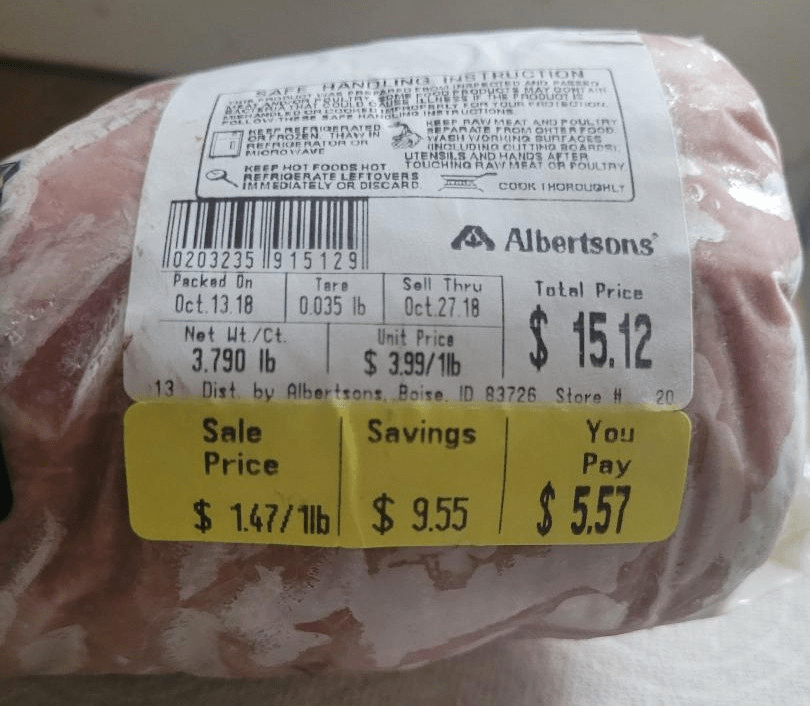 Is anyone terribly surprised that the results are savagely anti-climactic? No weird smells, no weird textures, no alarming gastric consequences. And this isn’t surprising. Packaged properly, which means wrapped tightly in plastic to exclude as much air as possible, and kept around 0-degrees, frozen meat will keep pretty indefinitely. I think the record around here is 11 years.
The really fascinating thing about these archaeological digs is noting how the prices of meat have changed over the years. I remember when I sometimes got 85/15 ground beef for a buck and ahalf a pound when it was on sale. Nowadays its around $5-6 a pound. Thus, when you see a sale….jump on it. Also, this is why a freezer and a vacuum sealer are must-have items.
I have a brisket in the freezer that I vacuum-sealed several years ago. I’ve been meaning to see if it’s still OK. May do that this weekend.
I have not tried this, but it looks legit.
I saw a sushi chef defrosting tuna. He said the problem most people make is that they just defrost it. When you do that, the cells rupture between -5 celsius and zero which causes the liquid to come out and the meat to be less palatable. He has a technique he says works. Take the meat out of the freezer and put in a bowl of lightly salted water (you want the salt percentage of the water to be the same as the meat so there is no water movement to equalize salt levels). Then you let the meat defrost in the salted water. When the meat is no longer frozen, take it out of the salt water bath, dry it off, and either refrigerate or cook. From a chemistry perspective, it seems solid.
If you search YouTube, you can probably find the original video.
Long ago I came across an article in Outdoor Life where an old timer would freeze his fish inside a wax milk carton filled with water. I’ve tried it and it works for all meats. The quart and half gallon stack nicely and provide sufficient mass to survive a short power outage. No freezer burn or loss of flavor/texture. I guess the solid chunk of ice keeps it sealed all around.
Freezing solid in water is great for keeping the air away.
We used to use that method when we would catch massive amounts of yellow perch out of Saginaw Bay. Worked like a charm.
So, did you just wrap in plastic, or also vac seal it?
Was already wrapped in plastic and sealed….just dropped it in the deep freeze and let it do its thing.
Do you not re-seal that plastic wrapped meat in another vacuum sealed bag? For a belt-and-suspenders approach?
If its already sealed up in heavy gauge plastic, it seems unnecessary.
Ah, right – a pork loin usually is packed like that.
If you have a full-service butcher you shop at they can usually pack things like that. I get chickens like that, IQF – Individually quick frozen, and sealed in a bag. They thaw out a little lopsided, but once thawed they cook up (roasted, grilled, used as part of a stew or whatnot) just fine.
And when I buy expensive meats (like a whole brisket) I get it like that, even if it’s not frozen.
When I was a youth in rural northern WI, that was the method to freeze chicken parts, cottontail rabbits, and squirrels. The big winter snowshoe hares filled a couple of cartons.
Lately I’ve worked myself into a section of my chest freezer holding several packages of venison backstrap from 2011. I process my own deer and this meat was wrapped simply in a single layer of freezer paper that has a coating that I put to the inside, against the meat. One or two pieces of the meat had a spot or two about the size of a dime that had freezer burned (dried out), but the rest of the chunk was as sweeet and fresh as you’d ever want. Decades ago I used to wrap my venison in a layer of Saran Wrap and then the freezer paper, but over the years I’ve determined it simply isn’t necessary so long as you give it a tight wrap and tape it well.
Bacterial growth actually only slows at zeroF, it decreases down to about-40 where it pretty much stops. There are charts in food sanitation manuals. Remember this from going to the Cold Storage with my Father(Industrial Chef) when he was getting samples for the lab.
Be careful that old of meat might not have all the latest “food like” substances for modern consumption.
I have resurrected meats from the bottom of the freezer will no problems. Only one was not great, a turkey about 10 years old or more.it had lost flavor somehow, but was edible.