
So, my plan is to have the gametrail cams (and for the sake of brevity we shall just call them trailcams from here on in) positioned at a few strategic points around the Beta Site for when I’m not there. Problem is, they rely on periodic battery swaps or recharging, and require a cell signal to send me updates and info. Now, I’m good with this for the time being. I picked up the solar panel and lithium battery pack to try out and I’ll be setting that up on my next trip up there. The ultimate plan, however, is, once something gets built, to put in a multicam DVR system like I have here in town. The drawback, of course, is going to be the power requirements. I currently run nine cameras here at the house. Each camera has its own 12v power requirement. Additionally, the DVR runs on AC power as does the computer monitor I use to watch the feeds. The ideal is to have a camera setup that goes to StarLink so I can monitor things remotely, including one camera pointed at a screen full of metrics like temperature, battery charge, etc, so I can make sure things are running smoothly when Im not there. Thing is, there is no power up there. Zero. So any system has to run on whatever power can be made available.
My understanding is that things will be more efficient if I can run everything natively on DC. (“Natively”, in this context, means that the devices were originally made to run on DC rather than AC devices that are running on AC that is coming from a DC transformer. Such arrangements, as I understand it, are not efficient.)
The cameras are DC, which means they can be run off of a battery system. And I can run a laptop monitor off of DC as well. (More on that in a few paragraphs.) StarLink, also, can be run on DC. So that leaves the one holdout being the DVR itself. I have to go hunt down if such things are available. But I also need to do some math and calculate what kind of power draw running, say, nine cameras 24/7, a DVR, a monitor, and StarLink will accrue. Then I need to imagine a battery system capable of running that type of thing and factoring how long it can run before the batteries get to , say, 50% charge. And then its a matter of calculating what kind of power input from a solar panel system is required and than scaling that to the anticipated need.
Perusing the internet has shown that many people are using PoE (power over ethernet) systems. It appears, though, that these require 48v and since power will be at a bit of a premium it may mean that a less modern 12v system of cameras and DVR will have to be the way to go.
On the bright side, I think I may have figured out one part of the equation. I was wondering about powering a computer monitor and I remembered that portable laptop monitors were a thing. I picked one up and and figured that since they were designed for use with a laptop, which is a portable DC device, perhaps I could have it simply run off a laptop-type battery.
Turns out, the particular one I picked up, runs off USB-C and mini-HDMI. Googled the specs on it and it says that it uses 9.4 watts of power. Asking Google what size battery would be required to run a 9.4 watt device for 24 hours gave me the answer that “To run a 9.4-watt device for 24 hours, you need a battery with at least 225.6 watt-hours (Wh) of capacity ( ). For practical usage, accounting for efficiency losses, you should use a 12V 20Ah Lithium (LiFePO4) battery or a 12V 40Ah Lead-Acid battery.”
Hmm. Well, a while back I picked up a large lithium power pack to charge my phones and radios. Specifically, this guy. The listing says 288watt-hours. So, in theory, one 24-hour cycle of use would reduce the battery by about 78%. Thats fine, I’ll worry about capacity later, right now I want to see if this will work as-is without any weird messing around with things.
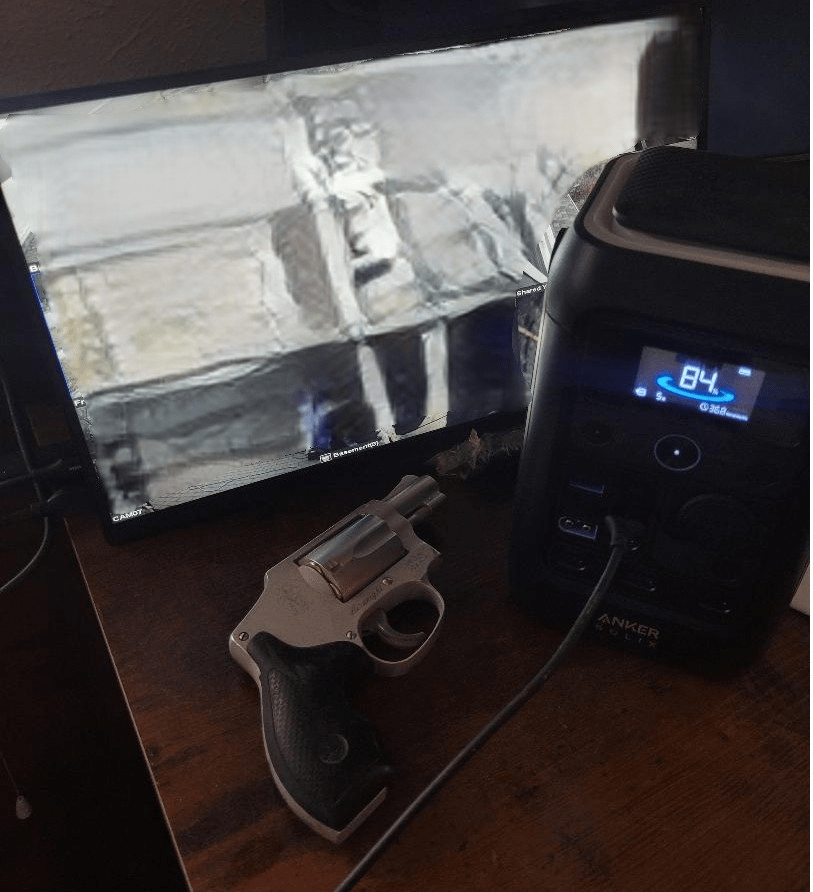
Well, yeah, of course I dithered out the images from the security cams. What are you, new here?
So, I unplugged the HDMI-HDMI cable from my DVR and plugged in the HDMI-miniHDMI cable that came with the laptop monitor. Then I grabbed a USB-C-to-USB-C cable and plugged one end into the monitor and one end into the battery pack. And it worked.So thats one part of the equation that I at least have a handle on.
Native DC is fine, unless you have longish cable runs, then line losses will lower your end-point voltage too low. I’ve only got 5 acres, but went with solar and local power for my cameras. Panel and / with battery packs have not done well for some reason. The integrated units work fine in the desert SW – unsure about NW woods. My receiving network has UPS on them to power whatever – in your situation I would go with a few full sized panels and a really big, deep-discharge lead-acid setup – golf cart size batteries (probably need to look at temperature issues for winter – again, I’m a desert rat.) You can easily run an inverter in your central location if you need some lighter AC power – or to run some solid state voltage boost units. Even the little Starlink mini killed my two large diesel batteries when I left it on for a couple of days while parked – you will need a some depth in your supply. I’ve got a few voltage converters around that are 12 to 24, 24 to 12, etc. – some losses and a little RF noise, but I can live with them. Adjustable input and out models also available on the jungle on-line sales website. Put the batteries, any inverters or voltage converters into an insulated box in a shed with minimal venting (H2 from batteries during charging can get interesting) and I bet it would work fine over the cold months.
PS, for lower loss, longer cable runs talk to well-drillers in your area. I’ve got 400 plus feet of four conductor very large conductor cable laying out by my well right now after doing an anticipatory replacement during recent pump replacement. There is another 1000′ laying out next to another well down the road just waiting for someone to go retrieve and use. Summarizing – I’d go with local power supplies for remote cameras, and a centralized lead acid power supply for the ‘cabin’ area with Starlink, hub, screen (not on when not home), and nearby cameras. Be sure to keep a fairly well hidden camera pointed at an obvious camera mounted near your most likely approach corridors – normal practice to catch those looking to defeat the system.
Forgot to mention – for warm weather, a mock (or real) bee hive box (the white ones) can be used to keep people away from places they don’t belong. Just look at others in the area and make it look like them to the casual observer. Well constructed, they make a good place to stash a camera – people have somewhat irrational fear of the little buggers.
Sure would be handy if you could tap into that water line to run a small hydro generator for cloudy and calm days.
Are you going to have a shed or something as a “base”?
Maybe a concrete floor and some tables in it…
If you were going high end, you could mount the solar on the shed roof.
https://www.amazon.com/dp/B0FRMQPZF6/
Reolink has a wifi camera series that comes with solar panels. Their home hub uses an external 12v dc power supply. It’s not officially supported, but folks are powering them with batteries.
Figure 10 watts for the home hub. The Starlink mini draws 15 at idle and can draw 50w in use, depending on conditions. You’re going to need a 140Ah battery or better if lead acid, that would be a 50% discharge. 200 watts of solar panels minimum, I would want more in case of cloudy days or snow cover.
Agree on Reolink (I’m the first anon poster) – they have worked well for me and the ability to put the solar panel remote from camera is nice for keeping it in a sunny place. I was pleasantly surprised with their WiFi range. Remote access with timeout feature seems to help with my solar-powered battery life, too.
Solar sizing is … complicated … but a couple hundred watts of panels and a couple hundred watt-hours of battery isn’t going to run starlink 24×7 in winter.
We actually have a computer at the cabin – the laptop display is indeed the low power option. A Raspberry Pi 400 is a low-watt way to run it. We use it to see the game cam pics on the ‘big’ screen and to watch DVDs in blizzards … roughing it :-).
We have quite a few cellular game cams. They run 4 months plus on eneloops. I don’t know exactly how long they will run, because we don’t go longer than that w/o being there to change them. How many electrons they use depends on how often they transmit; most of ours are set to transmit every detection. but wait 15 min between taking pics. We have a couple of the ones with an built in solar panel and they work fine if the location gets sun.
We do the 15 min delay because Spypoint lets you transmit 50 pics a month per camera for free. We have 20ish cameras up, so a few bucks a month per camera subscription would add up. If you don’t have a 15 min timeout the next windy day you get a pic every 2 minutes and run out of free pics for the month. Not the right strategy for everyone, but it works for us.
Lithium rechargeable batteries are specced to work down to -4 degF, and Montana’s mountains get colder than that, if you care. The eneloops have worked down to the coldest we’ve seen so far (-28).
A caveat for Spypoint: we have had good luck with their older ones (‘Link-Micro-whatever’). The newer ‘Flex’ ones are good news/bad news: the dual cell bands gives better coverage, but the AA battery trays are not so good; a lot of them have bad internal connections. You can fix by taking them apart and soldering, but that’s a PITA. The lithium battery packs are OK, and the clones off amazon work fine and are half the price. Spypoint is replacing the ‘Flex’ ones; dunno if the new ones have fixed the battery tray issue. If you are on a budget the spypoint web site sells refurb ‘Link-Micro’ ones for cheap from time to time; ours have been bombproof.
Purchase the Spypoint membership. It’s only $100 per year and upgrades you to 250 pictures per month for ALL your cameras, no limit. Spread that across 20 cameras for 12 months, and you’re only paying pennies a month for 5x the pictures. I purchased the membership and love being able to deploy more cameras at no additional cost!
A good neighbor that keeps and eye out for you is a worthy addition for whatever system you set up…
This is literally the best advice of all. Hopefully they are good neighbors. There’s an easy way to find out…
For 12 V DVRs, you could look at some of the systems designed for vehicle camera systems.
The potential limitations are number of channels and resolution, but power draw would be great for you.
Surveillance is all well and good, but what happens when it detects something that needs to be addressed? Jump out of bed, throw on the boots grab the heater and high tail it out there? Our place is low maintenance (four hour drive). If we aren’t on site, then there is no valuable stuff out there, got to have portability. A few old sleeping bags and some clothes, minimal food and some Harbor Freight tools, that’s it. If the critters get to it, no big deal.
Youre assuming that surveillance only has one purpose … security. Perhaps I want to see how much snow is actually out there snow I know what to bring or if I want to make the trip at all? Same thing for for rain and wind conditions. And if something does happen, securitywise, Im aware of it for my next trip there instead of walking into a surprise.
H/T Survival blog
https://survivalblog.com/2026/03/14/construction-design-remote-off-grid-residence-part-1-mrs-alaska/
This probably sounds dumber than a shit sandwich but do you think a system or parts of a system could be run using dewalt or Milwaukee batteries. More power than you need and rechargeable
Interestingly, Milwaukee makes a ‘generator’ that is basically just a block that takes a half dozen of their high-capacity batteries to create a heavy-duty giant power bank. https://www.milwaukeetool.com/products/details/m18-carry-on-3600w-1800w-power-supply/2845-20