
As I mentioned, parts are coming in for this project and will continue to come in over the next couple weeks. One of the things I’m doing now is math. Calculating things like how long a given load will be able to be supported assuming no battery charging, minimal charging, etc, etc.
The inverter is AC, meaning that it takes the DC from the battery and converts it to AC for use in regular appliances/tools that are designed to run off regular AC household current. The hiccup is that StarLink Mini runs natively on DC. That means that the simple way of running things, plugging the AC power supply into an outlet on the inverter, does a dance of converting DC (from the battery) to the inverter which converts it to AC, and then that AC powers the StarLink AC power supply plug which converts that AC to DC. And there’s a bunch of power loss in that DC to AC to DC conversion process. Add to that the overhead of powering the inverter itself. This means a bunch of energy from the battery is being wasted…perhaps unnecessarily.
Whats more efficient? Well, the battery is 48v DC, and Starlink has the omnivorous ability to run on pretty much anything from 12v (your average car/tool battery) to 48v. (Which is one of the reasons I’m so impressed by the thing. If you can make electricity from a waterwheel-alternator, solar panels, generator, or wind turbine, you can run one of these things through a wide range of voltages.) So, to an uneducated neanderthal like me, it sounds like all I really need to do is just run the StarLink straight off the battery for the most efficient usage.
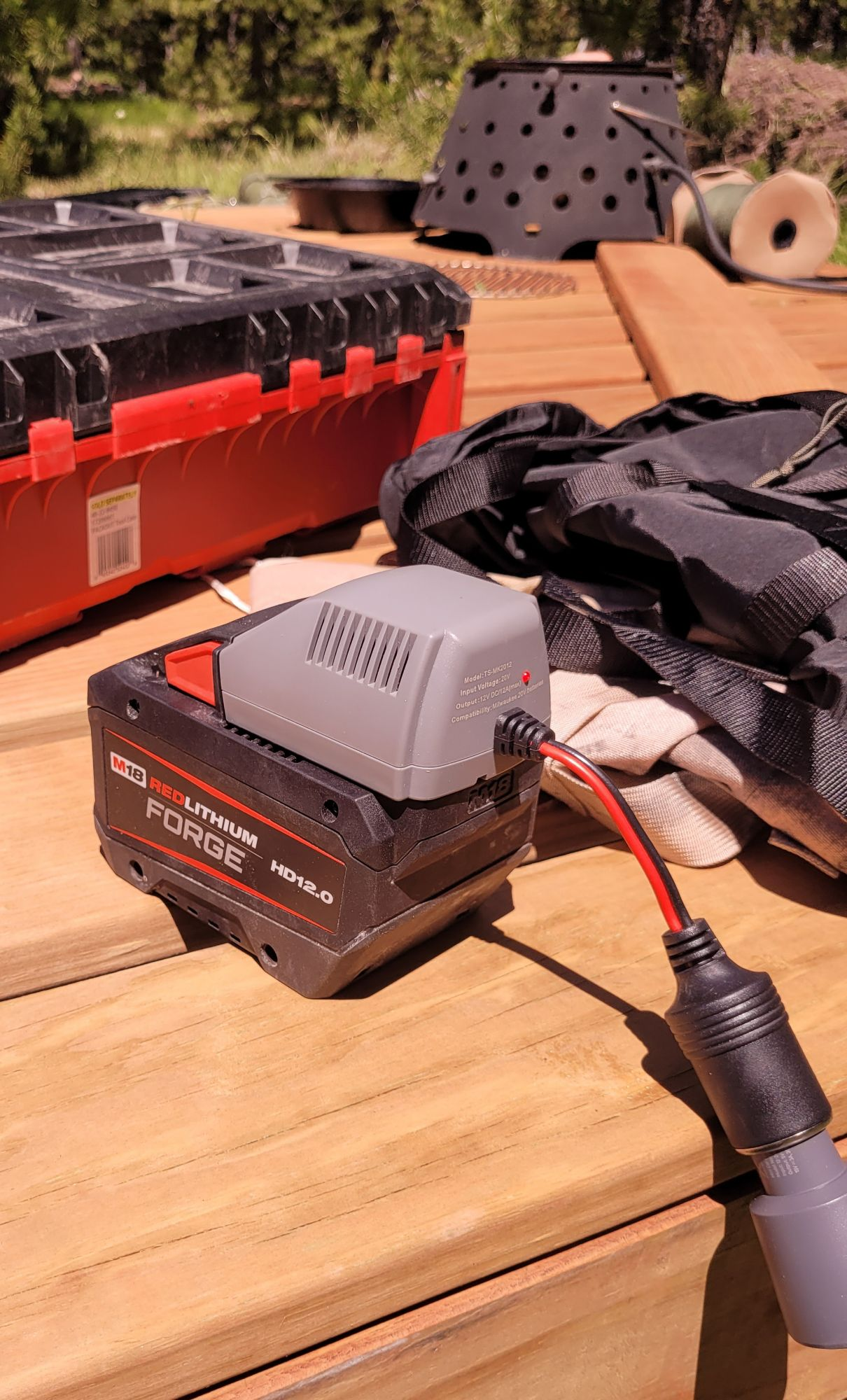
So then whats the purpose of the inverter? Well, it has a charge controller in there for charging the batteries from the solar panels, and, of course, at some point I’m going to need AC power for things like corded saws and other tools. Also, I have no freakin’ idea of what the future is going to hold so its probably a good thing to have capabilities that, although I may not be using them now, will be available for future use.
Right now the only thing I need to run up there is the StarLink to keep me in touch with the cameras. I don’t keep a stream going on my computer all the time, I simply check in once or twice a day on the cameras or as the ping me with alerts. This sort of usage averages out to about 20W or less. According to the math I see online:
Estimated Continuous Runtime (at 85%–90% Usable Capacity)
- ~15W (Idle / Standby): ~290–307 hours (~12.1–12.8 days)
- ~20W (Light / Steady-State Use): ~218–230 hours (~9.1–9.6 days)
- ~25–30W (Typical / Active Use): ~145–184 hours (~6.0–7.7 days)
- ~40W (Heavy Use / High Demand): ~109–115 hours (~4.5–4.8 days)
And those numbers assume no external inputs from the solar panels. The panels? At the moment I have six 590 watt panels, and mounts, on order. Since the current usage of up there amounts to about .5kWh per day, these panels, once set up in series, should be a bit of overkill…which I am fine with. Again, I am an uneducated neanderthal, but it appears to me that a 590 watt panel needs to produce approx. 480 watts to keep things at an even keel in terms of usage versus energy input. Or, in other words, Starlink uses 480W per day, so panels need to bring in 480W per day to keep things even. Since one panel is, ostensibly, rated to 590 watts, I would think that means that under perfect conditions, one panel would need about 49 minutes to produce 480W…meaning, I think, that the days needs would be met by one panel, under optimum conditions, in that time. But down here in the real world, nothing is perfect. So, assume 80% efficiency. That knocks the time for getting your 480W to just a hair over an hour. Call it one hour.
But, there are six panels, right? So mathematically doesn’t that mean that six 590W panels, operating at 80% efficiency (not to be confused with the % of efficiency of the panels themselves), would produce that same 480W in 1/6 the time of one panel? Thereby by producing the days worth of 480W for StarLink in ten minutes?
I think Mother Nature can begrudge me ten minutes of direct sunlight in a day. But, even without direct sunlight there is still some input and that input only has to equal, or surpass, the anticipated usage of 20Wh. Figuring six hours of daylight per day under worst conditions, thats 20Wh/6/6=.555~. Im probably carrying the math a bit far here, but that seems to say that if I can get a mere half a watt per hour, for six hours each day, from each panel, then electrical homeostasis is achieved. Mathematically, anyway.
I know in the real world these numbers probably represent some wildly optimistic thinking but…it pencils out on paper annyway. Guess I’ll find out how it works in real life as soon as I get the panels up on the roof of the conex.