Its only overkill if you don’t need it

So after the last large purchase of freeze-drieds, it was time to put the leftovers away. The freeze-drieds (FD) are packaged with an advertised shelf life of a minimum of around 30 years, and the experience of some folks seems to suggest that rating is pretty spot-on.

Thirty years…. I’ll expire before the food does.

But, the food only lasts as long as the container it’s packaged in. Now, I have had some MH sitting on the shelf for almost 20 years and it appears to be just fine. BUT….I have also had some #10 cans from the LDS cannery that eventually started to rust and look like they may be a bit sketchy. (One can had almost turned black with freckling, but when I cut it open everything was flawless inside…but there is no room for ‘probably ok’ when it comes to food storage.) Honestly, I do virtually nothing special to my #10 cans…I stick ’em in a cardboard box that holds six cans, tape it shut, and stick it on a wire shelf in my basement. Here in my part of Montana, the basement stays cool with virtually no humidity…optimal conditions. But, when a can of FD beef or chicken sets you back fifty bucks a can, it’s probably a good idea to maybe add an extra layer of protection. And some folks live in areas where the humidity can get downright troublesome…like, oh, the southeast US for example.

I’ve read a lot of stuff on how to store food long-term. Other than the ubiquitous statement about ‘a cool, dry place’, there are a few other suggestions on how to make sure your canned stuff doesn’t have it’s structural integrity compromised. The most detailed that I’ve read involves removing the labels from each can and ‘painting’ the can with (or dipping it in) melted paraffin. This seems like a pretty solid way to do things except that it also sounds like a tremendous pain in the butt. As I pointed out, there is an alternative. The folks at repackbox.com were kind enough to send me one of their kits that are designed to maximize the lifespan of the #10 can that’s housing the stuff that’s preventing you from having to eat your dog. I am always up for examining new gear..

So, starting at the top:

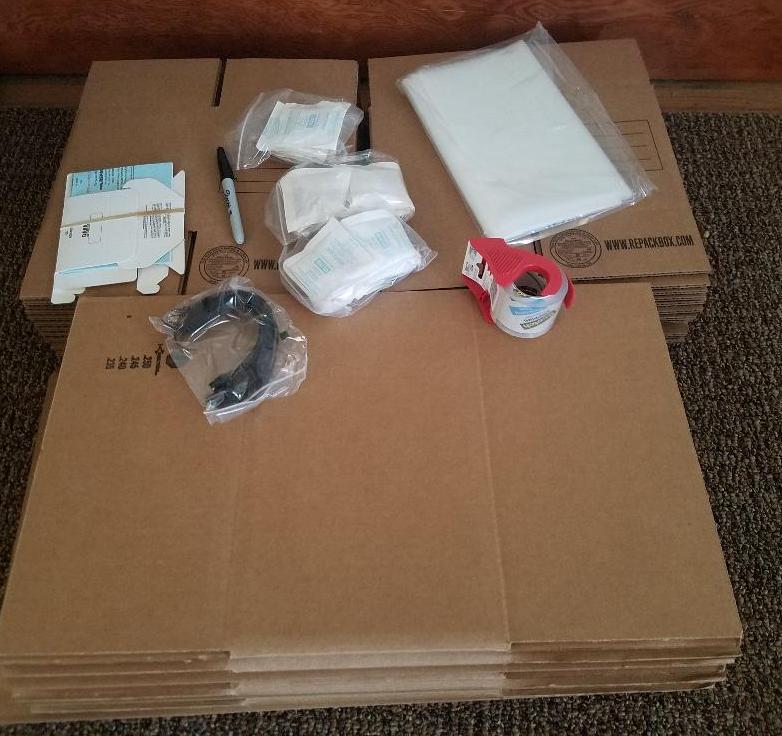
UPS dropped off a box and I was delighted at how much detail went into things. I mean, the storage boxes are marked with places to write down he contents of the box and then they provide a new black Sharpie for you to do the writing with. And a roll of tape to tape up the boxes. Literally, everything you need to pack your #10 cans for long-term storage is included…except for the shelves. Note to the guys at repackbox.com: find a bulk deal on surplus P38 can openers and include a couple with each overbox.

  • 24 boxes for individual cans
  • 6 overboxes that hold 4 individual boxes
  • 24 polybags
  • 24 dessicant packets
  • 24 zip ties
  • Sharpie
  • Roll of tape

So the idea is that you take your expensive can of yuppie chow, put it in the polybag, add a packet of desicant, ziptie the bag shut, seal it up in the small box, and then load four of them into the overbox. At that point you’re good to go for what will probably be the next hundred years.

Lather, rinse, repeat until all boxes filled. The boxes, by the by, are some heavy duty cardboard. Is it waterproof? Of course not, but thats why the cans are sealed in a polybag. Is this the sort of packaging that you could put together on your own? Maybe. I ship stuff for a living so I know all the sources for this kinds stuff. But…here it is, in one place, ready to go, and just a couple mouse clicks away.

For my current needs, this is overkill. But, overkill isn’t a bad thing. What I mean by overkill is that, for me and my current circumstance, this is more protection than seems necessary (although erring on the side of caution isn’t a vice in the world of preparedness). But…let’s say I was going to store a bunch of this stuff offsite at the Beta Site, or the family hunting cabin, or in the attic at my uncles warehouse, or under the floorboards of a family members kitchen…..well, then there’s really no such thing as overkill. Come the day when you’re fleeing the [zombies/hurricane/troops/tornado/alien overlords] and arrive at your hideout, tip over the fake woodpile, and untarp your cache, it’ll be hard to think “Man, I really didn’t need to pack that stuff as well as I did”.

The biggest issue I would think anyone would have with this sort of lily gilding is the expense. But, four cans of FD meat is $200. And then there’s the whole what-if-my-life-depends-on-it angle. Breaking the cost down, it’s about $2.91 per can to exponentially increase the level of  protection of your food supply.

Honestly, my own policy is probably that the stuff I store in my basement will probably not be packed like this. I mean, its in my basement…I can go downstairs and check on it every week if Im so inclined and stay on top of any issues. BUT…the stuff thats going to be tucked away Elsewhere…where I may not see it for a year (or years) at a time…well, that stuff is going to definitely get packed up like this.

So there you have it. There’s the old saying about how if your pants absolutely Must Not Fall Down that you go with suspenders and a belt…and then you sew your shirt to your waistband. This kit from repackbox.com is definitely the sew-your-shirt-to-your-waistband step of extra certainty. Go check ’em out.


Who you know

There’s an old saying that every man needs to have five kinds of people in his life – a forgiving priest, an understanding mistress, a loving wife, a friendly banker, and a good doctor.

I was doing a little business the other day and it occurred to me that my circle of acquaintances encapsulates the survivalist version of that…cops, gun dealers, gold/silver dealers, a couple medical professionals, and a few other ‘useful’ people. It was brought home to me when I was given this:

See, one of the people I know runs a business where he resupplies and maintains emergency equipment for businesses. One of his tasks is to pull expired components from the first aid kits in the vehicles of a large regional company. What happens to those expired items? Well, they get thrown in a big box and whoever wants ’em can have ’em. Since bandaids and gauze pads dont really ‘go bad’ I took ’em for supplying some tertiary-level first aid kits.

But….it’s useful to know people who are in such businesses. I still need to establish relationships with a good realtor, and a doctor. But…I’ve got a pretty good grasp on a rather eclectic mix of other useful folks.

Networking, baby…………..

Time flies when youre having…oh wait…

April 15 will be…:::drum roll::: the fifteenth anniversary of this blog. I do believe that might  make me the longest running blog about preparedness that is still active.

I should get an ice cream cake or something………


..hmm… yeah..an ice cream cake. Vanilla ice cream with chocolate cake.


Yeah.

Book – ‘Pulling Through’

By now we’re all familiar with the ‘handbook-as-novel’ concept in preparedness literature. You create a ‘how to’ guide and turn it into an illustrative story. It’s not a bad way to create a story, although you might wind up getting a little too heavy into repetitive detailed descriptions of gear (cough*Metalifed Python*cough).

Dean Ing, an author with some chops, wrote a book called ‘Pulling Through’. It was interesting not so much for the story, which was your average family-hunkering-down sort of yarn about a nuclear war, but rather for the fact that, literally, the second half of the book was a treatise on how to prepare to survive World War Three.

The story follows a bounty hunter who scoops up his latest charge just as nuclear bombs start exploding around his California neighborhood. He takes his charge to his home, which he’s had somewhat prepared for this sort of thing at the urging of his preparedness-as-fad sister. Eventually the rest of the extended family shows up and the story mostly chronicles the days they spend in the basement waiting for the worst of the fallout to subside. During this time they deal with inadequate ventilation, unexpected guests, escaped convicts, improvised lighting, improvised sanitation, improvised everything.

Dean Ing’s previous works are usually of a technical nature and Ing himself , in the second half of the book, paints the picture of himself as someone who has come to survivalism as a logical response to the threats of the time. The book came out around1983 which is right about where the new wave of survivalism was at it’s crest.

Is it a good read? It’s not bad…. it is quite realistic with people suffering the types of injuries and insults that you would expect in such a situation. People die of radiation poisoning and there’s plenty of descriptions of how that sort of misery looks. Gunplay? A shootout with real consequences, a standoff or two. Sex? Nope..a little hinted romance at the end, but that’s about it. Having read Ing’s other books, male/female pair bonding is not his strong suit.

What Ing’s strong suit is, however, is writing about technical things. In his personal life he’s been a hobbyist of airplanes, race cars, and other highly technical goodies. In short, he’s a good technical writer who, on occasion, can crank out a good book. (FYI, two of my favorites of his are ‘Spooker‘ and ‘Flying To Pieces‘.) The second half of ‘Pulling Through’ is Ing telling the reader about his experiments in surivivalism regarding technology and improvisation that he and his family have undertaken. Additionally, there’s a large chunk of that section of the book taken up with reprinting the instructions on how to make your own ‘Kearny Fallout Meter‘…an item which factors heavily in the story part of the book.

Good fiction makes you think and Ing does throw out more than a few situations in the book that make you wonder what you’d do in a similar situation. But, to be fair, he also throws in some oddball and esoteric details that show what a techie he really is.

Like a lot of books i like, this one is out of print. It turns up at the usual sources from time to time, though. This book isn’t really everyone’s cup of tea. It isn’t as epic as others, with virtually all the story taking place over the course of a week or two and mostly in one location, but like ‘Alas Babylon’ it was written by someone trying to urge people to take nuclear survival seriously. It’s not a great book, but it isn’t a bad one… it’s a good choice for people who are a bit nostalgic for the days when we all thought WW3 was just moments away.

I’d be curious to know if he stuck with his interest in survivalism some 35 years later.


Last call on leftovers

Here’s whats left from the group buy:
(6) MOUNTAIN HOUSE CHICKEN FRIED RICE WITH VEGETABLES #10 CAN ” $23.44
(2) MOUNTAIN HOUSE BEEF STEW #10 CAN $26.79
(1) MOUNTAIN HOUSE COOKED DICED BEEF #10 CAN $51.58
(3) MOUNTAIN HOUSE LASAGNA WITH MEAT SAUCE #10 CAN $26.79
(3) MOUNTAIN HOUSE CHILI MAC WITH BEEF #10 CAN $23.44
(6) MOUNTAIN HOUSE NOODLES AND CHICKEN #10 CAN $23.44
(4) MOUNTAIN HOUSE PASTA PRIMAVERA #10 CAN $21.43
(2) MOUNTAIN HOUSE SCRAMBLED EGGS WITH HAM AND RED AND GREEN PEPPERS #10 CAN $29.47
(3) MOUNTAIN HOUSE SCRAMBLED EGGS WITH BACON #10 CAN $29.47
(2) MOUNTAIN HOUSE GRANOLA WITH MILK AND BLUEBERRIES #10 CAN $29.47

Anyone who wants to come into Missoula, lemme know. There was about three times this much earlier so if you want something, lemme know so I can set it aside. Cash only. Offer ends next Friday.

Go deep

One is none, forty thousand is one.

It occurs to me that one of the better reasons for having a ‘group’, rather than being solo, is to have some folks to help you carry the damn ammo up and down the stairs. Whew.

This will be Deep Sleep ammo. For target and plinking I’ll use whatever is available at WalMart or wherever, but this stuff goes right in there with the Mountain House stuff. The only time I expect to see it again is during some enormous crisis or when I transport it to the Beta Site. And, for the record, each 40mm ammo can holds 8,250 rounds…or 165 boxes of 50. And they’re heavy….right at the limit of man-portability.

Inspection

Have a few (ahem) leftovers from the Mountain House group buy that are going into the Deep Sleep. I used this opportunity to adjust quantities of ‘broken case’ items. See, the boxes normally hold six #10 cans. If I have only five cans of, say, Diced Beef, that means that six-can box is short by one can…or, in other words, it’s a partial or ‘broken’ case. So, I used this opportunity to round out my broken cases. In the process it also gave me a chance to inspect things. Embarrassingly, according to the dates stamped on the box, the last inspection I made on these things was seven years ago. In reality I should probably inspect these things once every other year or so.

Why? Well, mostly just to check that nothing has started to rust or otherwise be compromised. Last thing I want is to be packing up one day to move to a new location, pick up a cardboard case and have a bunch rusted cans fall out the soggy bottom of the box. No, no, no,no. I did not spend this kinda money to just wind up heaving it in a dumpster someday because I didn’t take the time to do the things necessary to protect my stuff.

What sorta steps? Well, nothing terribly intricate. Everything is in a cardboard box, taped shut, the boxes are stacked at least two feet off the floor on wire shelving, away from electrical and water sources, and (in theory) routinely inspected for damage. If I really wanted to go balls deep on the preservation side of things, the guys at repackbox.com sell a kit for really going full Burt Gummer and protecting your investment. I might have to get that to try out and see how things hold up over time.

By the by, the oldest of the cans I have in storage are pre Y2k (in fact, they were purchased at a post Y2K sale) and the majority are about 14 years old. How have they held up? Pretty well. Labels havent peeled, can integrity appears solid, boxes show no damage….just a little dust on the boxes.


Things that annoy me #29,201

People who don’t understand the difference between: “Take me shooting” vs “Go shooting with you”

It’s the difference between “Cook me dinner” and “Have dinner with me”.

Case in point – my buddy texts me and says “Go shooting with me”. Ok, great. We go to the range, he sets up his targets and shoots, I set up my targets and shoot. He works on his gun, I work on my gun. We have some informal target practice. But we each have a good time and get to spend time doing our own thing.

Contrast that with “Take me shooting” which, when someone says that, means “Take me to the range, and make me the center of attention where everything is done for me and you get to accomplish nothing you want to accomplish. Hand me guns and ammo, you set up targets, watch me shoot, and make sure I have a good time.”

Now, I don’t mind taking people shooting if Im aware ahead of time that thats what Im doing. But saying “Let’s go shooting this weekend” and then have me be your personal instructor, target puller, brass catcher, gun fixer, and program director is not what that phrase means. When you say ‘lets go shooting”, to me, that means Im going to get to spend some time behind a gun and work on my own stuff as you work on yours and we’ll do some stuff together.

This is why I keep my circle of shooting buddies small. And why I usually go to the range alone.