Seasons Meatings

Minding my own business, wandering through the meat department…….

Well…let’s see…thats $3.33/# at 50% off. So it’s really $1.67/#. But…27% fat means, in theory, you lose 27% of that in cooking… so you’re really paying $2.28/# for the actual meat you pull out of the oven. But, for beef, $2.28 is still a good deal. In reality, this is getting mixed with a bunch of 93/7 that was similarly marked down, resulting in an 85/15 blend which is what we normally use for burgers and the like. So…meatloaf. (and , yes, I know in practicality you don’t lose the whole % of fat when you cook it. I just like the numbers game.)

When it comes to animal protein, it turns out that chicken is usually the least expensive. Pork is next least. Beef is the most expensive unless you somehow have a hankering for lamb. As a result, I tend to not eat much beef except for cheeseburgers. However, I do love me some meatloaf and if I can get the meat on sale….meatloaf.

Normally I would say that this is all going in the freezer but I’ve decided to take advantage of the sub-freezing temps outside to move all the frozen food outside in milk rates and defrost my freezer (and organize it). So, thats definitely an agenda thing today.

I didn’t go hungry in 2018 and I’m going to try and keep that streak going in 2019. Sales like this let me do that.

And, finally, a few people kicked in a few bucks with the donation button and wished me a happy holiday. I appreciate it, and I thank you very much. Every little bit goes towards keeping the lights on here at the blog, as well as sometimes allowing me the purchase for a piece of gear to beat the crap out of. Im sure someone is going to chime in and say “…and Rugers”. Nope. I actually keep a pretty tight rein on blog income/expenses versus my own expenses. Any money that comes in goes to hosting, domain registration, backup software, that sort of thing. On the extremely rare occasions that donations actually exceed those needs, I usually mark it for things that I can review and bring the results to you guys.


Butter

Well, I suppose that unless I take a sudden interest in French cooking, 20# of butter should last a year, right? I mean, thats a quarter stick of butter every 5 days. Seems like plenty.

In my experience, freezing butter, as is, from the store with no special packaging other than what it comes with is fine. But…better safe than sorry, y’know? I’ll vacuum seal each 1# brick just to err on the side of overcautiousness.

Yeah, there’s canned butter out there. Good stuff to have, no doubt, in a prolonged emergency but for my day-to-day needs, the stuff I buy at CostCo will do fine. Of course, if I was stocking some remote cabin or somesuch it would be a different story.

Anyway, this stuff will go off to the deep freeze and we’ll see if it lasts to next December. I suspect it will.

Gobble gobble

There is a LOT of turkey,  Butterballs marked down 50%, going into the freezer this week. I actually had to do some shuffling around to fit them all in there. Vacuum sealer is getting a workout. Yay turkey!

And thats just the first trip to the store…..

Long term turkey dinner

Hmm.. the turkey was from November 2016, the box of stuffing was from 2013, the can of corn was from 2017, and the instant spuds were from 2008. And…it all tasted (and digested) just fine. I was tempted to break out some of the freeze dried blueberry cheesecake from 1999 but was too lazy.

The take away? You can do a fairly appropriate Thanksgiving meal out of food storage and the deep freeze.

And today? Post Thanksgiving turkey bargains, m’friend.

ETA:

I have a $25 gift card to purchase Butterball products.
My local Albertsons has Butterballs marked down to $0.99/#

Mathematically, it is within my ability to purchase a 25# turkey with absolutely no out-of-pocket cost to me. And I just checked…they have a bunch that are close to that weight.

Turkey soup, turkey chili, turkey sandwiches, turkey gumbo.
It’s about to happen.

Adventures in food storage

Todays “Lets See What Happens” episode is a six year old can of corned beef hash. Nominal ‘best by’ date was three years ago. So….how is it?

Fine. Of course.

Properly canned food lasts pretty much indefinitely. This can features the pre-scored ‘pop top’ feature that don’t really like in canned goods. If you drop the can or pressure is applied against the pre-scored region the can will fail more often than if it were not pre-scored. But, unfortauntely, these small single-serve cans were not available without the pop-top features. But…they held up just fine.

Storage conditions? Just sitting in the back of my kitchen cabinet for six years. Nothing special.

And that’s sort of the point. While I fully appreciate the nitrogen sealed, ceramic lined #10 cans filled with freeeze dried meats that will last longer than I will…..I also appreciate that modern food canning processes, by first world companies, do an awesome job of creating a product that will last a long time. Sometimes there is a need for a $40 can of freeze-dried pork chops, but sometimes you’ll get along just fine with a case of Kirkland canned pulled pork. It just depends on a few other things like if you plan to transport it, what the storage conditions will be, etc. I love me some long-term food but, really, you can put together a very reasonably long-term food supply without breaking the bank on ‘survival food’.

I bet the folks in whats left of Florida would be happy to have some hash and eggs for breakfast after a long evening of clearing debris and unblocking roads. A case of this stuff, a #10 can of powdered eggs, a case of instant oatmeal, a case of fruit cocktail cups, a jar of Tang, instant coffee, some hash browns, and you’ve pretty much got a breakfast that’ll last five-ten years.

As I’ve mentioned, around this house the food storage paradigm is short-, mid-, and long-term storage. This stuff counts as ‘mid-term’ storage….it’ll be good for more than a year or two but probably not out at the twenty year mark. I wish I had written the price down, I’d be curious to see where the price went.

For science!

Well, I can’t say Im surprised but Joel over at TUAK called it quits on his storage food experiment after a couple days. Yes, I kinda predicted it but you gotta give the man credit for giving it a shot.

The big takeaway from all this is that, like first aid kits, you’re probably better off building your own ’30 day kit’ rather than stocking up on an under-caloried, over-salted, under-flavored, and over-priced packages.

Here’s a website that I really found fascinating: Safely Gathered in: Recipes. The recipes all use foods that store well and are therefore excellent candidates for your pantry.

Sadly, they haven’t updated in a while, but the info there is, in my opinion, highly useful.

By the case? Buy the case….Pt IV

About 18 months ago my local Albertsons had a good sale on pasta and I took advantage of it like Bill Clinton takes advantage of interns. Well, that sale came back and I decided i could use a few(!) cases of rigatoni.

Shopping carts are for amateurs. When the Zero stocks up, he goes deep.

Savings? Well, according to my receipt, what normally would have cost 238.80 came out to sixty bucks. (Got careless, forgot to ask for the 10% case discount.)

The apocalypse will be a fairly carbohydrate-heavy experience what with all the rice and pasta in storage, it seems.

In actuality, this is mostly my desire to have a large amount of day-to-day use items on hand in case some sort of financial donkey punch occurs. When you show up at work one day and your boss says “We’re being bought out by another company. This office will close in three weeks. Good luck.”, you really want to have some of the expensive niggling details (like food) locked down. Also, I just feel calmer and more at peace when I look at the shelves and see boxes and cans of food, racks of toiletries, paper towels, soap, detergent, and all the other consumables that keep my quality of life above that of some Third Worlder.

Wouldn’t it make more sense to stockpile the cash instead of the food if I am worried about such things? Well, yes…except for that part about the fabulous sale. Lets put it this way: You have $60 cash in hand..save it or buy food? If you’re worried about a job loss, for example, and you’ve tied that $60 in food, then you only have that one thing (food) covered. But if you keep the $60 in cash, you can use it to buy food..or fuel..or electricity. So does that mean it makes more sense to stick that $60 in the bank? Nope.. heres why: I didn’t buy $60 worth of food. I bought $240 worth of food and paid $60. Or, put another way, if I stuck that $60 in the bank, when I used it in the future I’d get only $60 worth of food. In this particular case, my purchase power today was 4x what my purchase power would be with that same $60 later.  (Disregarding inflation, which would actually make todays purchase more than 4x the purchasing power.) The more clinically minded of you will say “Wait, we’re drifting into Time Value Of Money country..” Yes. Yes we kinda are.)This doesn’t mean you shouldn’t put money away as part of your preps…it just means that you need to think about things past the obvious. Maybe you already do that..I didn’t used to. Preparedness is really about resource management in regards to risk reduction – we try to get the most for our money when we take steps to protect ourselves from future problems.

Regardless, I’m pleased with todays purchase. It’s more food on the shelf and one less thing I have to worry about acquiring when/if I hit an economic rough patch.

Meat

I really think the meat department manager sees me enter the store and he goes to hide in the freezer rather than deal with my bargain hunting.

But…his lackey was not so fast. So….93% lean ground beef. $5.99/#. And then it was on ‘sale’ by.50/#. Okay, so now we’re at $5.49/#. Thats no bargain. BUT….since today was the last day of expiration, it was marked down an additional 30%. Now it’s time to try and set the hook…

“Hey…I see you’ve got all this ground beef marked down 30%.”
“Yeah, it expires today.”
“If you mark it down 50%, I’ll take all of it.”
“Uh..let me go in the back and check. I think the manager is in the freezer.”

And he comes back with a roll of ‘50%’ off stickers and starts applying them to the dozen trays of beef. End result? About 20# of extra lean for around $2.75/#… not great, but quite respectable.

It’s these little victories that add up. Anything that gives me an excuse to heave 20# of meat into the freezer is a good thing. Add in the pasta and spaghetti sauce sale from last year, and I can make a giant pot of rigatoni with meat sauce for $4.25, which comes out to less than a buck and a half a meal for three extremely generous (read: unhealthy) portions.

So, 93/7 isn’t great for burgers, but….blend it with the outrageously fatty 73/27 I got and you wind up with about 85/15…which is pretty much right where you wanna be for a cheeseburger.

Food is no laughing matter, man. I remember a time when I literally had nothing in my fridge except ketchup and not much else. When I can load up the freezer without unloading my wallet….well, you better believe I’m gonna jump on that.

Its only overkill if you don’t need it

So after the last large purchase of freeze-drieds, it was time to put the leftovers away. The freeze-drieds (FD) are packaged with an advertised shelf life of a minimum of around 30 years, and the experience of some folks seems to suggest that rating is pretty spot-on.

Thirty years…. I’ll expire before the food does.

But, the food only lasts as long as the container it’s packaged in. Now, I have had some MH sitting on the shelf for almost 20 years and it appears to be just fine. BUT….I have also had some #10 cans from the LDS cannery that eventually started to rust and look like they may be a bit sketchy. (One can had almost turned black with freckling, but when I cut it open everything was flawless inside…but there is no room for ‘probably ok’ when it comes to food storage.) Honestly, I do virtually nothing special to my #10 cans…I stick ’em in a cardboard box that holds six cans, tape it shut, and stick it on a wire shelf in my basement. Here in my part of Montana, the basement stays cool with virtually no humidity…optimal conditions. But, when a can of FD beef or chicken sets you back fifty bucks a can, it’s probably a good idea to maybe add an extra layer of protection. And some folks live in areas where the humidity can get downright troublesome…like, oh, the southeast US for example.

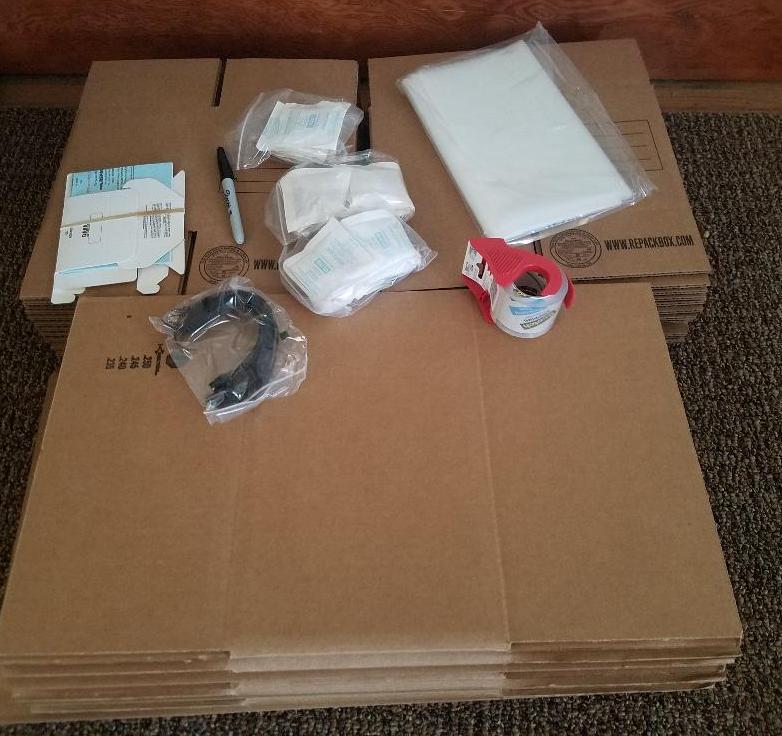
I’ve read a lot of stuff on how to store food long-term. Other than the ubiquitous statement about ‘a cool, dry place’, there are a few other suggestions on how to make sure your canned stuff doesn’t have it’s structural integrity compromised. The most detailed that I’ve read involves removing the labels from each can and ‘painting’ the can with (or dipping it in) melted paraffin. This seems like a pretty solid way to do things except that it also sounds like a tremendous pain in the butt. As I pointed out, there is an alternative. The folks at repackbox.com were kind enough to send me one of their kits that are designed to maximize the lifespan of the #10 can that’s housing the stuff that’s preventing you from having to eat your dog. I am always up for examining new gear..

So, starting at the top:

UPS dropped off a box and I was delighted at how much detail went into things. I mean, the storage boxes are marked with places to write down he contents of the box and then they provide a new black Sharpie for you to do the writing with. And a roll of tape to tape up the boxes. Literally, everything you need to pack your #10 cans for long-term storage is included…except for the shelves. Note to the guys at repackbox.com: find a bulk deal on surplus P38 can openers and include a couple with each overbox.

  • 24 boxes for individual cans
  • 6 overboxes that hold 4 individual boxes
  • 24 polybags
  • 24 dessicant packets
  • 24 zip ties
  • Sharpie
  • Roll of tape

So the idea is that you take your expensive can of yuppie chow, put it in the polybag, add a packet of desicant, ziptie the bag shut, seal it up in the small box, and then load four of them into the overbox. At that point you’re good to go for what will probably be the next hundred years.

Lather, rinse, repeat until all boxes filled. The boxes, by the by, are some heavy duty cardboard. Is it waterproof? Of course not, but thats why the cans are sealed in a polybag. Is this the sort of packaging that you could put together on your own? Maybe. I ship stuff for a living so I know all the sources for this kinds stuff. But…here it is, in one place, ready to go, and just a couple mouse clicks away.

For my current needs, this is overkill. But, overkill isn’t a bad thing. What I mean by overkill is that, for me and my current circumstance, this is more protection than seems necessary (although erring on the side of caution isn’t a vice in the world of preparedness). But…let’s say I was going to store a bunch of this stuff offsite at the Beta Site, or the family hunting cabin, or in the attic at my uncles warehouse, or under the floorboards of a family members kitchen…..well, then there’s really no such thing as overkill. Come the day when you’re fleeing the [zombies/hurricane/troops/tornado/alien overlords] and arrive at your hideout, tip over the fake woodpile, and untarp your cache, it’ll be hard to think “Man, I really didn’t need to pack that stuff as well as I did”.

The biggest issue I would think anyone would have with this sort of lily gilding is the expense. But, four cans of FD meat is $200. And then there’s the whole what-if-my-life-depends-on-it angle. Breaking the cost down, it’s about $2.91 per can to exponentially increase the level of  protection of your food supply.

Honestly, my own policy is probably that the stuff I store in my basement will probably not be packed like this. I mean, its in my basement…I can go downstairs and check on it every week if Im so inclined and stay on top of any issues. BUT…the stuff thats going to be tucked away Elsewhere…where I may not see it for a year (or years) at a time…well, that stuff is going to definitely get packed up like this.

So there you have it. There’s the old saying about how if your pants absolutely Must Not Fall Down that you go with suspenders and a belt…and then you sew your shirt to your waistband. This kit from repackbox.com is definitely the sew-your-shirt-to-your-waistband step of extra certainty. Go check ’em out.

 

Inspection

Have a few (ahem) leftovers from the Mountain House group buy that are going into the Deep Sleep. I used this opportunity to adjust quantities of ‘broken case’ items. See, the boxes normally hold six #10 cans. If I have only five cans of, say, Diced Beef, that means that six-can box is short by one can…or, in other words, it’s a partial or ‘broken’ case. So, I used this opportunity to round out my broken cases. In the process it also gave me a chance to inspect things. Embarrassingly, according to the dates stamped on the box, the last inspection I made on these things was seven years ago. In reality I should probably inspect these things once every other year or so.

Why? Well, mostly just to check that nothing has started to rust or otherwise be compromised. Last thing I want is to be packing up one day to move to a new location, pick up a cardboard case and have a bunch rusted cans fall out the soggy bottom of the box. No, no, no,no. I did not spend this kinda money to just wind up heaving it in a dumpster someday because I didn’t take the time to do the things necessary to protect my stuff.

What sorta steps? Well, nothing terribly intricate. Everything is in a cardboard box, taped shut, the boxes are stacked at least two feet off the floor on wire shelving, away from electrical and water sources, and (in theory) routinely inspected for damage. If I really wanted to go balls deep on the preservation side of things, the guys at repackbox.com sell a kit for really going full Burt Gummer and protecting your investment. I might have to get that to try out and see how things hold up over time.

By the by, the oldest of the cans I have in storage are pre Y2k (in fact, they were purchased at a post Y2K sale) and the majority are about 14 years old. How have they held up? Pretty well. Labels havent peeled, can integrity appears solid, boxes show no damage….just a little dust on the boxes.