Mill arrival

Almost five weeks after I ordered it, the grain mill I ordered finally arrived. NGL, I was starting to think it wasn’t going to ship at all. And, in the intervening time, the price rose almost 25% as availability shrank. But..it’s here.

Impressions? Definitely a product that is built to last. But…I ordered the spare parts nonetheless. My biggest problem was that I simply don’t have the counter space, nor the sturdiness of construction, that this thing will require. So, I gave it some thought and came up with something that seems to work.

First consideration was space. I cant just go buy or build a sturdy little bench and bolt this thing to it. I just don’t have room for that. Secondly, whatever I bolt it to has to be able to resist the forces exerted on the mill. In other word, if I start really leaning into this thing I need the mill and its mounting surface to not walk around or wobble.

Solution? Black and Decker Workmate WM225.

I mounted the mill to some scrap lumber, and then c-clamp that to the bench. The bench folds flat like a folding chair when not in use, so the footprint is minimal. And, thanks to physics, if I stand on the bench’s step while turning the mill handle I cannot lift the mill or the bench….for the same reason you cant stand in a bucket and lift yourself up in it. So…that works.

The mill itself looks like it’ll last a lifetime. I tried grinding up some hard white wheat and the result was a very fine flour. Changed out a few parts, threw in a handful of dried corn, and experimented with several different grades of fineness.

I will say that I can see why some people motorize these things. But, I picked up the extension handle for it so the extra leverage makes a big difference.

I haven’t done much, if any, baking in a while so I’ll have to see how the taste of fresh ground flour and cornmeal compares to what I’m used to.

Also, I can see where it might make sense for me to go pick up another 16-gallon ‘blue barrel’ and dump another hundred pounds of wheat or corn into it… just in case. A couple hundred pounds of each should last for quite a while.

Yeah, the mill was a major hit to the wallet but over the rest of my anticipated life span that knocks it down to something like a dime a day for a tool that will last forever and help keep me and the people I care about fed.


Stock options

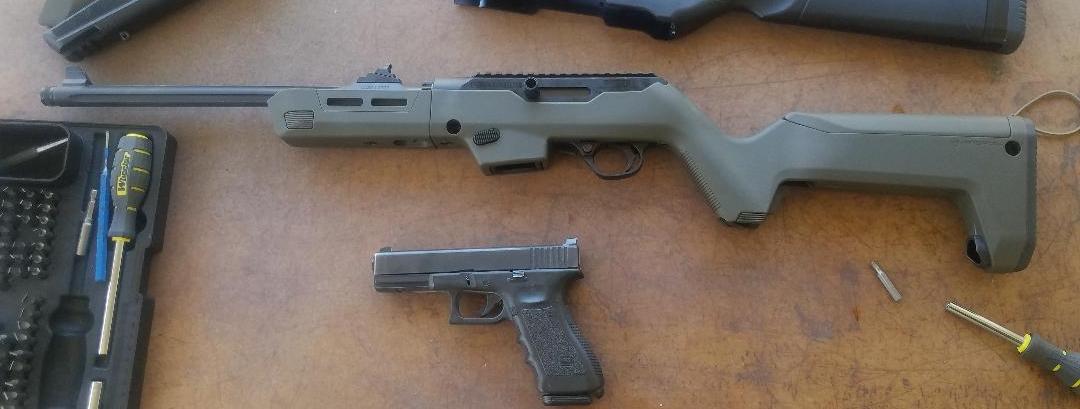
The Magpul backpacker stock for the Ruger PC9 showed up today.

I compared it side by side with the backpacker stock for the 10/22 and its is almost exactly the same size.

The stock is pretty much exactly the same as the Backpacker 10/22 stock, but the compartment in the stock that would normally hold a handful of 10/22 mags is now designed to fit one Magpul 21-rd 9mm magazine. Handy. Interestingly, ulike the 10/22 version, it came with a second cover for the stock compartment. This other cover acts like a riser to, presumably, give you a higher cheek weld for use with optics. Other than that..same stock, basically.

Like the 10/22 version, there’s no provision for a sling unless you order up some Magpul QD sockets. Annoying, but I suppose I can see why they went that way.

And, since TPIWWP:

Before….

…and after.

Buttstock offers a compartment with enough room to store a Magpul 21-rd Glock mag.

G17 for size comparison. This is almost the exact same size as the 10/22 version of the Backpacker stock.

The stock was about $150 from Brownells, but it’s a much better choice, IMHO, than that original Ruger stock. The QD swivel points are useful, the onboard mag storage is a major plus, the color is practical, and the way the barrel assembly locks to the stock to keep everything together in one unit is a really nice feature.

So, worth the money? In my opinion yes. I’ll take it out this weekend and do some shooting with it, but I expect it to perform just fine. Magpul has a pretty good reputation for doing stuff right.

Lifestraw video

This is rather interesting, if true:

Again, I have no idea if this is true or not. But if it is, then it seems to suggest the LifeStraw is living up to it’s advertising.

These things come up on sale at Amazon once in a while and I always keep one in my bag when I’m out in the woods. While it’s true you can “last three days without water” you’ll really, really wish you died on that first one when you drink bad water. Being in a ‘survival situation’ is already fraught with hazards…why add ‘dying of a terminal case of the runs’ to it?

Advertised as being good for 1000 gallons of water, that would mean you could drink about 2.75 gallons a day for a year outta this thing. But, be real…most emergencies that require this sort of device are going to be of much shorter duration…a few days or a week. At which time, with a replacement cost of less than twenty bucks, toss it and get a new one.

As I said, I’ve seen these come up for sale on Amazon every so often and I think they’re a piece of gear thats worth having around in quantity. For real convenience, they make a water bottle with the filter built in…which means when youre on the run you just scoop your bottle through the creek or river, cap it up, and start drinking. I can see that as being a very handy thing.

I usually wait for a sale on Amazon but, geez, with the way things are going these days you have to juggle ‘supply chain issues’ (Read: shortages) against saving a few bucks.


Concrete Lego

I freakin’ love the idea of these.

Of course, I could see a couple problems. First, unless you’ve got some lovely earthmoving equipment at your disposal, moving these things by yourself or with just one or two trusted friends is going to be difficult. Then there’s the matter of having enough concrete on hand….a wheelbarrow and shovel, or a portable mixer from the tool rental place, ain’t gonna do it. And then theres the matter of time…if you can only afford one mould, its going to take..what? days…for one block to dry and cure. And when you may need hundreds of blocks…well, thats a lot of time.

I suppose you could buy the mould and make a deal with a local concrete supplier. Give him the mould(s) and as him to make you as many blocks as you need. But, then you’re still locked into the transport and privacy issues.

A smaller version of these might make more sense. I sure do like the idea, though, of concrete Lego. Just the things for building outbuildings and that sort of thing. And probably make excellent anti-vehicle barriers for the perimeter of the property.

Cool idea, lotsa potential. Logistics is a bit tricky though.

Canning stuff

I have all the things necessary for home canning, and I do occasionally engage in the practice. I don’t do it often because I don’t really have much need to…after all, I can always buy commercially canned vegetables and meats at pretty much any grocery. However, just because I can do something today doesn’t mean I’ll be able to do it tomorrow. Also, sometimes I cook stuff that I rather like (bunker gumbo ) and like to have some of it sitting on the shelf for a quick meal.  And, of course, when the wheels really fly off civilization and the electricity becomes a pleasant memory, I’ll have a whole freezerfull of meat that needs to suddenly be repackaged in a shelf stable manner. Canning lets me do that. And, if you’re the type with a big garden and good hunting skills, canning lets you put a lot of food away at very reasonable prices.

Anyway, I was in the local independent supermarket getting my lunch at work the other day and as I walked by the aisle where they keep the home canning stuff I saw these:

A couple cases of wide-mouth lids. And not that cheap Chinese-made crap that has been showing up on the market:

Seriously…if you’re willing to purchase this crap because it’s $2 cheaper than Ball or Kerr, you deserve the problems that are going to come from these things. From what I’ve read they don’t seal well, don’t hold seal well, are spotty in the application of adhesive, and tend to buckle. Sure, their availability may be better than Ball or Kerr, but if you have to throw away the food, or make three attempts to get a good seal, or worst of all, go into your pantry six months from now and find a jar of what looks like vomit, was it really worth the ‘savings’?

Being a good survivalist, I spoke to a few LMI and asked if they needed any lids. Why not? If the world is going to sink into another World War or Great Depression then I want those people to have every advantage possible. Short version: I want a world with more of them and less of everyone else. Brutal, but true.

One person mentioned that they hadn’t ‘gotten into’ canning yet. Picked a hell of a time to start, I told him. He said he was waiting for a course at the continuing education facility to be offered. Dude, it ain’t rocket science and time may 9or may not) be of the essence. So, for those of you who haven’t experienced the joy of filling your kitchen with heat and steam, here’s youre shopping list:

Information…don’t start a trip without a map. There are plenty of good books on the subject, the one I use and recommend is:

Read it, read it again, and then flip through it another time. Nothing magical about canning…anyone can do it. But spoiled food is dangerous ‘food’ and you really want to pay attention to what you’re doing,. It’s no different than reloading ammo in that regard…it isn’t difficult, but you do want to pay attention.

I like the pressure canning, which is necessary to can meat or any food that contains meat (sauces, stews, etc.). This is gonna be the most expensive part of the process. Just resign yourself to spending the money and know that this thing will literally last you the rest of your life. It doesn’t use a gasket so if you’re concerned about replacement part availability, this is a great choice. I use this particular model:

Yes, not cheap. But I’ve had mine for a long time and haven’t had a lick of trouble from it. This particular package comes with tools that you’ll want….lid lifter, jar lifter, spatula, food funnel, etc.  One-stop shopping. But this baby will let you can everything and in large quantities. Its big and heavy, so no glasstop ranges for this monster.

After that, its time for lids, jars, and bands. Most any hardware store (during normal times) will have them. You can’t have too many. Jars are reusable as long as they aren’t chipped at the mouth. Bands are reusable. Lids are not. Yes, some people reuse them. I don’t. Food poisoning is not worth trying to save $1 by reusing a lid or two. I don’t have the time to investigate every brand out there so I usually just stick to Ball as my first choice and then Kerr. Lots of people ‘inherit’ jars from grandma or some great aunt’s estate…thats fine but inspect them thoroughly for chips or damage.

All this stuff will fit in a large plastic tote that can sit on your basement shelving when you’re not using the canner. Find a great deal on meat? Can it. Neighbors had a bumper crop of tomatoes or something? Can ’em. Made a huge batch of vegetable beef soup and want the convenience of just heat-n-eat out of a jar? Fire up the canner.

As I said, I don’t do much gardening these days but I do hunt for bargains on meat. And when I do find a deal on meat canning it saves me freezer space, is convenient, and allows me to store a good bit of animal protein against whatever is coming. And if nothing happens? Well, it’ll still taste just fine and I’ll have saved a buncha cash.

Evolving from Fenix 12 to 12 v2.0

So the term “EDC”, as you know, has become the handy prepper acronym for ‘Everyday Carry”. It’s also used as a noun in interrogatives, such as “Hey man, show us your EDC” which is an invitation for every swingin’ johnson to dump his pockets on the bunk and display magazines, ammo, knives, watches, multitools, pens, flux capicators, or whatever they think they need to have on them at every moment of every day.

Theres only a handful of things that I keep in my pockets – wallet, flashlight, pocketknife. And, surprisingly, the flashlight gets quite a bit of use. So, imagine my annoyance when I discovered that I somehow lost my Fenix E11. Not a big problem since they now make the E12 which is virtually identical. Put when I went to Amazon to replace the E12 I pulled out of storage, I discovered that the E12 is also now history. Instead it has been replaced with the E12 V2.0. So..I hit the buy button.

Here’s the skinny on the E11 and E12 line of little AA-batt flashlights. For the money, I like these a lot. I’d like a SureFire even more but given that I just lost my last E11 I’m reluctant to spend $200 on a flashlight that has a higher than 50% probablity of winding up lost and rolling around  on the floor at CostCo.

I got the new E12 V2.0 yesterday and it is as handy as my older ones, but has some differences. It is slightly narrower in diameter than the older ones, although the emitter section is of the same diameter. It is also noticeably shorter, which Im not sure I like. The shorter length makes it hard to hold in your fist and operate with the thumb. But, the more compact design is welcomed by my pockets. Biggest difference is that the tailcap switch has three modes…low, med, high..which means if you want a small task light for reading menu’s in a restaurant of finding your dropped wallet in a darkened theater you can do so without lighting up the area like a movie set. Also, theres a very welcome and remarkably clever belt clip that allows you to orient the light up or down when you carry it.

Price is about the same..$27~ so no real change there. My experience has been that these are excellent little flashlights for everyday pocket carry. Pretty unobtrusive, puts out a good amount of light, pretty bombproof, run on easily acquired AA batts, and have features that make them more useful than 3-for-$5 pocket lights you find at Horror Fraught..I mean, Harbor Freight.

YMMV, of course, but if you’re looking for a solid performing little pocket life that can withstand alot of abuse and won’t break thebank, this might be worth looking at for you.

Video – Jerry Cans: The True Secret Weapon of WWII

I fully recognize that there have been , since WW2, advancements in design, materials, and manufacturing process. It is not unreasonable to believe that there would be a better designed, better made alternative to the NATO-style (or Euro-style) fuel cans. Certainly there are devotees of the Scepter cans, and I’m sure they have their strengths, but I’ve been using the metal NATO-style cans for 20+ years and I have a difficult time thinking that a plastic can, even a super heavy-duty one, like the Scepter is going to be as leak-proof and as durable.

These last few posts have been about fuel because, well, I’ve got it on the brain since I watched it jump almost twenty cents in a day. And watched what it did to my monthly fuel budget. (Man, I could sure go for some $2 gas and some mean tweets right now.)

Anyway, although I’ve posted about history of these types of cans before, I thought this video might be interesting for those of you out there who weren’t aware of the interesting history of these gems.

Pretty cold

I’m an advocate of ‘stay with the vehicle’ for those times when you wind up, for whatever reason, unable to proceed any further…could be snow, vehicle malfunction, bad gas, whatever…if you’re in the middle of nowhere and your vehicle cannot proceed the thing to do is stay with the vehicle. Don’t believe me? Search the blog using the tag ‘strandings’ and read what comes up.

Staying with the vehicle is easier if you have the necessary gear, and I like to think I keep the vehicle stocked with the necessary gear. So, when its 0-degrees out and the wind is howling, is that surplus military sleeping bag really going to keep you from losing toes, ears, fingers , and nose to frostbite? Assuming you survive?

Let’s find out.

I keep a military sleep system in the vehicle year-round. Its an okay system and the price is right – free at most military standdowns. I have a half dozen in storage. Are they actually warm down to 0 degrees? Well, last night was at zero so I decided to test it out. I rolled out the GI sleeping mat, laid out the sleep system..inner bag, out bag, bivvy sack…stripped down to socks, shorts and a t-shirt, and climbed in. First off all, that transition of several seconds from ‘fully dressed while standing outside in 0 degree weather’ to ‘partially dressed but huddled in a sleeping bag’ was…intense. Once in the bag it was huddle in a ball until things warmed up. And then….not bad. I basically cinched everything up so my nose and mouth poked through the hood of the bag and left it at that. I’m not going to say it was toasty, but it was warm enough I could fall asleep and it was, without a doubt, warm enough that I wouldnt lose body parts to frostbite.

While I was cocooned in the bag, I used my phone to entertain myself and see what the official weather was.. -1 with winds around 12-15mph. And there were gusts that I could feel rippling across the bivvy sack, which did a nice job of being windproof.

I suspected that the military sleep system would be adequate and it was. This was laying on the ground in an unprotected and open area. Used in a vehicle, which would offer some material benefits in terms of protection from the weather, the MSS should be pretty much ideal. Better bags out there? Absolutely..but the MSS come out cheap enough that you can have a couple in a vehicle and not break the bank.

Drawbacks? A tad snug. Bulky as hell, but since it’s just sitting in the truckbox that isn’t really an issue. but, more importantly, experiments like these give me faith in a piece of gear and thats got quite a value all on its own.

So, if all you keep in your rig is a couple blankets, or, worse, a ‘space blanket’, I invite you to wait for a nice, clear, bitterly cold night and try them out for a few hours. Its the kinds of experiment that costs nothing but can pay off some big dividends…especially next time you get stuck in your vehicle in the dead of winter.

Case musings

Someone asked me how I store all those magazines.

Answer: The same way I store anything that I feel is important, worth protecting, and might be in storage for a long time: in a hard, airtight, watertight, crushproof container.

For 99% of the things I put in the Deep Sleep, the container of choice is either a genuine GI ammo can of some kind, or a Pelican (or similar brand/quality) case.

Good, quality, name-brand, effective, just-what-the-doctor-ordered cases are not cheap. Only you know how much risk you’re willing to take to save a few dollars. Will the plastic ammo can from Harbor Freight store gear just as well as a GI ammo can? Maybe. If it’s just going to sit on the shelf in your basement for the next twenty years then all it has to do is sit there, quietly waiting in the dark for that one day when life changes in an exciting new way. And that is when the extra bucks you paid makes a difference. When you grab the can off the shelf, swing it around as you run up the stairs with it, it bounces off the doorway as you grab your backpack with your other hand. You run out the door and it’s five inches of snow and freezing rain as you literally toss the ammo can in the back of the truck into a pile of slushy snow and ice. Then its a two hour drive over bumpy roads until you get to your safe place. Then you drag your gear out of the truck, some of it falls and hits the ground, some bounces off other gear, and some just gets none-too-gently shoved into a corner of the room. Now, your headset radios, battery chargers, cables, batteries, and other gear were in those cans… which would you rather have used to store those items – the $7.50 harbor Freight made-in-China plastic “GI” ammo cans or the $65 Pelican case?

Everything I put away for the future is put away because I have concerns about those things being unavailable in the future. Maybe they are unavailable due to price..or legislative action…or simple supply/demand variations…the reason doesn’t really matter; all that matters is that this particular item is now unavailable and whatever ones I have are the only ones I’m gonna have. So…I don’t mind spending the extra money for what I feel is a heightened level of protection.

Of course, not everything requires a super-high level of protection. A Glock magazine can get dropped, bounced off the concrete, get wet/snowy/dusty/dirty and survive just fine thank you very much. Not the same story for a radio. Or your medical gear. Or your other critical-and-somewhat-fragile gear.

Only you know what is and is not important enough to you to warrant the expense of high-end protection. It’s very subjective. Personally, my opinion is that anything worth putting away for the uncertain future is worth protecting as much as possible so it’s there when I need.

You’re going to have to do some math in your head. If the Made-in-China case affords you 75% the protection of the Pelican or Hardigg case is that 25% difference in protection worth the difference in price? Does the 80/20 rule apply here? As a friend of mine said when I complained about the cost of a motorcycle helmet, “Whats your head worth?”

It seems ridiculous to spend as much on a protective case as you did on the item that you are protecting, but, again, whats it worth to you to have exactly what you need, when you need it, in perfect working condition?

As I said, I’m a bit of an evil ‘yuppie survivalist’ so I spend the dollars for the Hardigg, the Pelican, the SKB cases. Or, if they’ll do the job, the virtually new genuine GI ammo cans. It’s just not worth it to me to go through the pain and labor of buying a piece of expensive top quality gear, house it in a POS knockoff plastic ammo can, and then have the lovely surprise of having that item absolutely not work when I need it most. At that moment the last thing I’m thinking is “Man, sure glad I saved thirty bucks by buying that cheap just-as-good-as-Pelican case.”


Mora

It’s a not-a-secret in the preparedness community that the ‘Mora’ knives are, it seems, quite the bang-for-the-buck. They’re a no-frills sheath knife of simple materials, simple construction, and they apparently do knife-tasks pretty well.

I was curious to examine one and form my own opinion since a) I had never gotten to handle one and b) I’m always looking for an excuse to buy gear (which, really, is pretty much why this blog exists). So, I trundled off to Amazon and ordered a couple. Specifically, these::

I mean, for eighteen bucks, why not? As an aside, the Glock knives that I like for their affordability and ruggedness are twice the price.

So whaddya get for eighteen bucks? Well, I wouldn’t call it a survival knife, although like any edged instrument it can certainly be pressed into that service…whatever service that may be. It’s not something for breaking windows, prying open door jambs, hacking through doors, or that sort of thing like my BK&T stuff. But 99% of the time, my knife needs are…cut stuff, slice things, poke holes in things. And this knife looks like a good choice for that. I’d call it a ‘sportsmans knife’. It’s quite well suited for cleaning out fish and deer, campsite chores, and that sort of thing.

The internet will show people ‘testing’ knives by ‘batoning’ them…where they put a knife on the edge of a log and then hammer it down through the log to split it for kindling. I suppose that’s a test of durability or something. I think the best test is to simply use it and abuse if for a season or two and see what shakes loose. I’ll take it out this hunting season and see if I can disassmble Bambi with it. If it turns out to be a good piece of gear I’ll pick up a half dozen for keeping in storage. And if not…hey, its only eighteen bucks.