Ruger Mini-14 magazine followup

So I had a fairly lousy experience with the aftermarket magazine that came with the Mini-14GB I picked up a few weeks ago. I really shouldnt have been too surprised since the prevailing wisdom is that, currently, there are NO acceptable aftermarket mags. Now, as much as that was a bad experience at the range, paying $30 (dealer cost, mind you) for a factory magazine is an even uglier experience.

Now, an important distinction really needs to be made here. I almost always prefer factory mags (or .gov contract mags) to aftermarket mags for my guns. BUT…for a non-critical gun, or what we can basically call a ‘range toy’, I don’t mind aftermarket magazines. (I mind junk aftermarket mags, but a good aftermarket mag is acceptable.) So, since this Mini-14 isn’t really on my radar for an End Of The World sort of thing, I don’t mind using aftermarket mags if they are good aftermarket mags.

(However, in the name of transparency, I will say that I am going to pick up four factory mags ‘just in case’.)

Anyway…

Over on YouTube there’s a gear/guns channel I watch from time to time that does the sorts of gear evaluations I like – they buy the gear, they test the gear, they beat the gear, the review the gear. They had a video up on the Tapco aftermarket mags and they got great reviews. Ok, let’s get a few and see what they’re offering………

  • Overall Impression
  • Metal reinforcement and lockup
  • Basepad and follower
  • Legacy gear compatability
  • Pricing

Overall Impression

Tapco has been (and somewhat still is) the source of many memes and disdain in the gun community. Their name has even been made into a verb – “Bubba got that SKS and he Tapco’d the hell out of it. Look at all that crap!” But, apparently, they are making a pretty slick Mini-14 magazine.

The Tapco Mini-14 magazine resembles a Magpul PMAG in many ways. The follower is very reminiscent of the Magpul, and the overall ‘feel’ of the polymer/plastic is also very similar.

Metal reinforcement and lockup

These mags are the second generation of Mini-14 mags from Tapco, the first generation did not have a metal reinforcing tab where the engagement/lockup of mag-to-gun took place. As a result, wear and deformation could occur that would cause magazines to seat improperly which, naturally, leads to reliability issues. Case in point: look at this aftermarket metal magazine which it appears could have stood a little heat treating. The post-in-hole lockup area is pushed inward from repeated magazine insertions. As the metal pressed inwards, it made seating the magazine securely more difficult which exacerbated the problem by trying to ‘force’ the mag to seat…which just pushed the metal further inwards.

The Tapco magazine has a steel clip surrounding the front of the magazine to take the wear and resist this sort of issue. Lockup in my particular Mini-14 was good. There was some play, as is to be expected, but it was ‘play’ not ‘slop’. More importantly, there were no reliability issues with feeding. (This can be seen on AK mags, which use a somewhat similar method of magazine retention…there’s usually some play, but nothing that affects function.)

Basepad and follower

The magazine basepad and follower are going to seem familiar to anyone with a bunch of Magpul PMAGs. The followers are very non-tilt and they move smoothly up/down within the magazine body. The basepad is a bit chunky, but has a very easy to manipulate locking mechanism making magazine disassembly a breeze…much easier, IMHO, than GI AR mags.

Legacy gear compatability

A big problem with polymer mags is that, dimensionally, they do not have the same ‘footprint’ as their metal counterparts. For example, a metal Mini-14 mag and the Tapco both hold 30-rounds but the Tapco is longer and a bit wider. This can cause problems in terms of fit in pouches that were designed, ostensibly, for AR mags. ‘Legacy’ gear..those AR pouches you’ve collected over twenty years…may not be the best fit for the bulkier Tapco mag. Modern pouches, though, often have adjustable flaps on them and those help tremendously.

I found that the mags did fit in open-top pouches, although they were a tiny bit snug. In magazine pouches that utilize a flap closure, they did not fit unless the flap was adjustable.

AR mag pouch with a non-adjustable closure flap. Tapco mag is too long to allow flap to close. Fortunately, most mag pouches with flap closures these days are adjustable.

Tactical Tailor stock-mounted mag pouch for AR mags. Note that it has a velcro adjustable closure flap.

This mag pouch can do double-duty …. AR or Mini-14 mag. Or, really, any other similar magazine since the adjustable flap closure provides the ability to accommodate other mags.

Single-mag pouches like this one work fine except the retention straps, though elastic, are a bit too short to accommodate the longer Tapco mag. Left: Metal Mini mag, Center: Tapco mag, Right: GI AR mag. SpecOps magazine pouch.

Double-mag pouch with velcro adjustable flaps holds two Tapco mags with no problem. Heavy ribbing on mags makes withdrawing one mag a little tricky. Pouch: Blackhawk

A possible issue (or non-issue) I noticed is that the Tapco mags have aggressive ribbing on the magazine bodies. You will get a sure grip on the magazine. However, stack two mags together in a pouch and one mag will get a sure grip on the other. If it’s a snug fit for two mags in your mag pouch, expect some ‘rim lock’ as you try to pull one mag out. Again, a single-mag pouch should be fine.

No stripper clip guides on the Tapco mag. Not sure if that’s important to you or not, but sometimes it’s a ‘nice to have’.

So, how’d they shoot? Shot fine. Put about a hundred rounds through them and didn’t have a hiccup. Mags fed fine, locked open on last round, seated and extracted just fine. Certainly a better performance than I got from the no-name aftermarket mag and about the same performance I would expect from a Ruger factory mag.

Pricing

Pricing? Well, retail is for suckers so I usually pay dealer prices. Dealer on these was around $12, so I would expect to see them in the wild around $19.99. For comparison, a Ruger factory mag is, dealer, $29.85. And that’s dealer price.

As I said, this isn’t a run-out-the-door rifle for me, so I’m okay with quality aftermarket mags. But…I wouldn’t feel terribly disadvantaged with these Tapco mags if I got dropped into Katrinaville with a Mini-14 and a dozen of these.

Historically, it has been a bigfoot-hunt to try and find an aftermarket mag for the Mini-14 that was reliable. The only aftermarket mag I ever found that worked perfectly in the Mini-14 platform was the old Eagle 35-rd mags and they haven’t made those since the ’90s. These Tapcos seem to have cleared the bar on a good aftermarket mag finally coming to market. Your mileage may vary, of course, but I ordered a dozen more for myself and think it was a very good purchase.

Its only overkill if you don’t need it

So after the last large purchase of freeze-drieds, it was time to put the leftovers away. The freeze-drieds (FD) are packaged with an advertised shelf life of a minimum of around 30 years, and the experience of some folks seems to suggest that rating is pretty spot-on.

Thirty years…. I’ll expire before the food does.

But, the food only lasts as long as the container it’s packaged in. Now, I have had some MH sitting on the shelf for almost 20 years and it appears to be just fine. BUT….I have also had some #10 cans from the LDS cannery that eventually started to rust and look like they may be a bit sketchy. (One can had almost turned black with freckling, but when I cut it open everything was flawless inside…but there is no room for ‘probably ok’ when it comes to food storage.) Honestly, I do virtually nothing special to my #10 cans…I stick ’em in a cardboard box that holds six cans, tape it shut, and stick it on a wire shelf in my basement. Here in my part of Montana, the basement stays cool with virtually no humidity…optimal conditions. But, when a can of FD beef or chicken sets you back fifty bucks a can, it’s probably a good idea to maybe add an extra layer of protection. And some folks live in areas where the humidity can get downright troublesome…like, oh, the southeast US for example.

I’ve read a lot of stuff on how to store food long-term. Other than the ubiquitous statement about ‘a cool, dry place’, there are a few other suggestions on how to make sure your canned stuff doesn’t have it’s structural integrity compromised. The most detailed that I’ve read involves removing the labels from each can and ‘painting’ the can with (or dipping it in) melted paraffin. This seems like a pretty solid way to do things except that it also sounds like a tremendous pain in the butt. As I pointed out, there is an alternative. The folks at repackbox.com were kind enough to send me one of their kits that are designed to maximize the lifespan of the #10 can that’s housing the stuff that’s preventing you from having to eat your dog. I am always up for examining new gear..

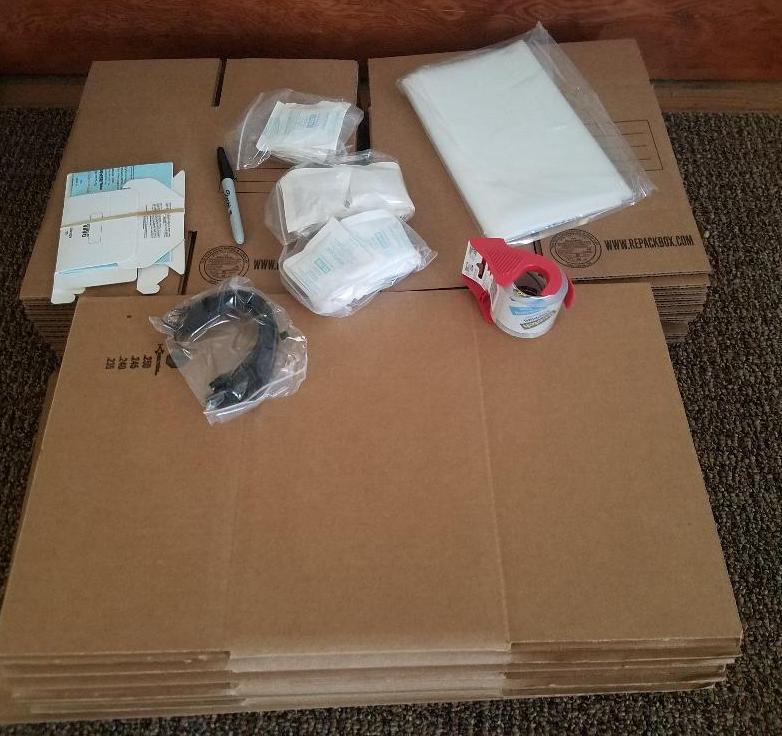
So, starting at the top:

UPS dropped off a box and I was delighted at how much detail went into things. I mean, the storage boxes are marked with places to write down he contents of the box and then they provide a new black Sharpie for you to do the writing with. And a roll of tape to tape up the boxes. Literally, everything you need to pack your #10 cans for long-term storage is included…except for the shelves. Note to the guys at repackbox.com: find a bulk deal on surplus P38 can openers and include a couple with each overbox.

  • 24 boxes for individual cans
  • 6 overboxes that hold 4 individual boxes
  • 24 polybags
  • 24 dessicant packets
  • 24 zip ties
  • Sharpie
  • Roll of tape

So the idea is that you take your expensive can of yuppie chow, put it in the polybag, add a packet of desicant, ziptie the bag shut, seal it up in the small box, and then load four of them into the overbox. At that point you’re good to go for what will probably be the next hundred years.

Lather, rinse, repeat until all boxes filled. The boxes, by the by, are some heavy duty cardboard. Is it waterproof? Of course not, but thats why the cans are sealed in a polybag. Is this the sort of packaging that you could put together on your own? Maybe. I ship stuff for a living so I know all the sources for this kinds stuff. But…here it is, in one place, ready to go, and just a couple mouse clicks away.

For my current needs, this is overkill. But, overkill isn’t a bad thing. What I mean by overkill is that, for me and my current circumstance, this is more protection than seems necessary (although erring on the side of caution isn’t a vice in the world of preparedness). But…let’s say I was going to store a bunch of this stuff offsite at the Beta Site, or the family hunting cabin, or in the attic at my uncles warehouse, or under the floorboards of a family members kitchen…..well, then there’s really no such thing as overkill. Come the day when you’re fleeing the [zombies/hurricane/troops/tornado/alien overlords] and arrive at your hideout, tip over the fake woodpile, and untarp your cache, it’ll be hard to think “Man, I really didn’t need to pack that stuff as well as I did”.

The biggest issue I would think anyone would have with this sort of lily gilding is the expense. But, four cans of FD meat is $200. And then there’s the whole what-if-my-life-depends-on-it angle. Breaking the cost down, it’s about $2.91 per can to exponentially increase the level of  protection of your food supply.

Honestly, my own policy is probably that the stuff I store in my basement will probably not be packed like this. I mean, its in my basement…I can go downstairs and check on it every week if Im so inclined and stay on top of any issues. BUT…the stuff thats going to be tucked away Elsewhere…where I may not see it for a year (or years) at a time…well, that stuff is going to definitely get packed up like this.

So there you have it. There’s the old saying about how if your pants absolutely Must Not Fall Down that you go with suspenders and a belt…and then you sew your shirt to your waistband. This kit from repackbox.com is definitely the sew-your-shirt-to-your-waistband step of extra certainty. Go check ’em out.


Book – “Alas Babylon”

This is the book that I think could widely be regarded as the gateway drug into preparedness fiction, and probably to some degree the gateway to developing an interest in preparedness in the first place.
I first read AB when I was 13 years old and it solidified a feeling and interest I’d only recently become aware. (No, that OTHER feeling.) Written back in the halcyon days of the late 1950’s, AB is probably the ‘cleanest’ of the nuclear war novels that followed. By ‘clean’ I mean that there is an absence of the sort of brutal imagery that we’ve come to expect in books about nuclear war. The violence is minimal and not graphic, no one dies of slow starvation, the citizenry isn’t roused to action against a cannibal army, and the characters don’t experience a dramatic renaissance of personal development that leads them into becoming some sort of ‘Red Dawn’-esque ersatz militia. The book simply tells the story a a man, his neighbors, and how they cope with the aftermath of a nuclear war that devastates their region.

For people like you and I who have read tons of literature on the subject, and have a basement full of freeze drieds, you’ll find the book to be a bit frustrating at times with the mistakes or lack of insight that the charcters show to their situation. But the book wasn’t written for survivalists…rather it was written to encourage people to think about survival. The author, whose real name was Harry Frank, wrote the book from the perspective of someone who believed that Americans needed to be more proactive in preparing for a possible nuclear exchange with the Soviets. To this end he wrote AB to illustrate his points.

The action in the book takes place mostly in Florida, in a small town where the main character resides. The cast of characters include pretty much everyone you would see on an episode of The Andy Griffith Show in Mayberry. One interesting thing to note is the 1950’s-era way in which blacks are portrayed. Hey, it was 1959 when this thing was written and ‘colored’ was considered a perfectly good word back then.  Notably, Frank addresses this issue in a very forthright way – the poor black family down the road winds up being an asset to the community as much as any other group and is never treated as anything less than equals.

What’s so wonderful about AB is that unlike many end-of-the-world books, it wasn’t really written with the idea that the main character (or any character, really) has any background at all in survivalism. It seems like in every book there’s always that one character..usually a retired military veteran of some kind…who winds up turning the whole crew into competent guerilla fighters (Lights Out, One Second After, etc.) That sort of thing is absent in AH. Oh, there’s a retired admiral that is a good supporting character but his influence isn’t anything like what other books in this genre show.

Alas Babylon isn’t a difficult read…I read it at 13-years old and found it to be light reading of the easiest kind. But it’s an enjoyable read. The characters are fairly simple, with no real backstory beyond a paragraph or two about their initial history, but it’s still a good story and there is enough variety in the characterizations that it’s easy to find someone you can empathize with.

Good fiction, as I’ve said, make you think. Alas Babylon was one of the first books I’d read in this genre and it certainly made me think about things I hadn’t thought about before. As the book progresses, characters lament the loss of their batteries, matches, soap, fishhooks, and all those other little consumables that we take fro granted. It’s a good example of how the small details in life get overlooked and by the time you realize you should have stocked up on salt (or .22 ammo or instant coffee) it’s too late.

Having been around for almost 60 years it is not difficult to find a used copy of Alas Babylon in pretty much any used bookstore. Even if it doesn’t sound like something you would be interested in reading…not enough zombies or gunplay for you, perhaps…..it is still absolutely worth reading simply because it is the book probably most singlehandedly responsible for influencing most survivalists.

So…no cannibal army, minimal (but reasonably likely) gunplay, no gear-heavy descriptions of equipment (cough*Ahern*cough), and no zombies. But….you do get a good story, set in an interesting time, written by someone who wanted to gently nudge the reader rather than hot them over the head with a hammer. In that regard, given how much this book is cited by survivalists as being influential in their lives, I’d say Frank did a good job.

Available from the usual sources.


Streamlight Siege

You guys remember Hydrox cookies? If you couldn’t pop for real Oreos, you bought Hydrox. Much like how if you’re on a budget, you don’t buy Frosted Flakes but rather the generic store brand ‘Frostie Flakes’ or some such (Slogan: “Theyrrrrrrrre….okay”.)

To me, Streamlight has always been the working-class version of SureFire. Yes, Streamlight has, as I read it, been around a tad longer than SureFire but SureFire gets the rep as the ‘high end’ tacticool product. (Interestingly, Hydrox came out before Oreos, as well.)

20160731_142828I’m kind of a gear snob, but I’m a pragmatists even more. A few years ago Streamlight came out with a product that, as far as  I know, has no comparable version from SureFire…the Streamlight Siege. (Although, to be fair, Eveready and a few others make a similar product but I don’t believe it to be as rugged and well thought out as the Streamlight product.)

The Siege is an LED lantern for area lighting. Nothing remarkable about that, but as you look the product over more closely you get the idea that it was designed for a very particular demographic….we happy survivalists.

20160731_143108The Siege runs on three D-cell batteries….one of the most common sizes of batteries around. Just about everyone has a couple D-cell MagLites floating around the house or car..the Siege takes advantage of that common battery. If you really want to streamline things, there are battery adapters that allow you to run one size of battery in devices meant for a larger size. Most often we see this with adapters that let you run AA-batts in devices that were meant for D-cells. But, my logistics revolves around three battery sizes (AA,D, and CR123) so I have plenty of D-batts laying around. (Interestingly, it seems like virtually the only thing I have that runs on D’s these days are flashlights. The days of radios and other devices running on D-batteries is coming to a close. )

20160731_142908The light source for the Siege is four white LED’s, and a fifth red LED. Holding down the one control button toggles between red or white. When the white LEDs are selected you have a choice of three brightness levels, starting with the highest. When the red LED is selected you have one brightness level, but double-clicking the button puts the red LED into SOS blinky mode.  The plastic ‘shade’ of the Siege diffuses the glow of the LEDs and is removable if you want more harsh lighting.

The top and bottom of the Siege has rugged rubber ‘bumpers’ making the light pretty resistant to being dropped, knocked over, or just banged around. Theres a foldaway clip on the underside of the light for hanging it upsidedown when you have the shade removed, and there’s a bail handle on the other end to hang it from whatever is handy when you do have the shade on.20160731_143039

The non-skid tread on the bumper-like bottom of the light keeps it from sliding on slick surfaces and provides an excellent grip for unscrewing the base to change batteries.

Light output on low is enough to illuminate a room so you don’t trip over anything, on high it’s bright enough to get things done but you’ll still feel like you’re in a power outage. Where this light seems to really shine (as it were) is as an emergency ‘area light’. When the power goes out its the light you turn on and stick high up in a corner of the room, hang in the stairwell, or put in your emergency gear storage area. It’s an awesome emergency light for when the power goes out and you need some light to get your gear together or start up your secondary systems (generator, transfer switch, etc.)

I haven’t beaten the crap out of it yet, but it has rolled off my desk a few times, and once bounced out of the truck….seems to still be doing just fine. Your mileage may vary. Personally, I’ve been very pleased with mine and will be getting three or four more as spares/backups/loaners.

They’re available at the usual sources, like Amazon, but once in a while you can find an outdoors-gear vendor having them on sale. Even at regular price, though, they’re a good purchase.

Streamlight Sidewinder cont.

When I was a kid, I loved playing with flashlights. One time I came across a military anglehead flashlight and I was a bit perplexed. All the flashlights I had played with previously were basically tube-shaped with the light coming out of one end of the tube. The GI flashlight was bent into an L-shape and holding the flashlight to get the beam pointed in front of you wasn’t as natural a movement as with the other kind. So…why the awkward design?

Of course, as a little kid it didnt occur to me that when your hands are full (as with a rifle or gear) you needed to hang the flashlight on your webbing and for it to point straight ahead the flashlight had to be in that L-shape.

Nowadays there are several ‘wearable’ flashlight for this sort of thing. A few years back I purchased a Streamlight Sidewinder. It’s been part of my casual everyday carry gear for a while now and it’s worth remarking on how it’s held up and how satisfied I am with it.

The Streamlight Sidewinder is, basically, a 2-AA battery flashlight with four different colors of bulb, and four settings of intentity, with a swivel head. That’s the short version. Longer version is that I’ve found it to be an immensely useful small flashlight. Many times I just drop a little 1-AA light in my pocket and go with that, bur for a more dedicated kit or layout of gear, the Streamlight is my go to.

First off, it’s available with four different color LEDs. You can do white/blue,red/IR or white/blue/red/green. I went with the IR model since you never know when you’ll need to have that sneak factor working in your favor.

The light has one knob with a push button that controls all functions. Push and hold to turn on, and continue to hold to cycle through four levels of brightness. Double-click for flashing strobe mode. Twisting the knob, rather than pushing it, selects which LED is active. There’s a tactile index point so you can select LED’s in the dark.

20160715_184035The Sidewinder has a captive battery compartment lid, which I think is an awesome touch and a sign that someone really sat down and put some thought into this thing. No need to worry about losing the battery compartment lid in the tall grass or in the dark if you’re changing batteries. There are also tactile indicators for battery polarity so you can, literally, change batteries in the dark or with your eyes closed.20160715_183954

The Sidewinder clips to your webbing or whatever using a spring metal clip on the back. In addition to the clip, there is an attachment point for a lanyard or keeper so your light doesn’t go missing if you take a tumble.

The base of the unit is flat, and in conjunction with the adjustable angles head allows you to set the light on a flat surface and point the beam where you want it. One disadvantage is the range of motion for the swivel head…if you have the unit seated on your webbing or otherwise on your shoulder/chest the head doesn’t swivel down enough to light the ground at your feet…it’ll light the area directly in front of you, but not directly beneath and in front of you. This can be remedied by carrying the light upsidedown on your person, but be careful it does’t slide off your gear and get lost.

It’s an excellent light for what it’s designed for – navigation and detail stuff. It’s not the sort of thing you use to light up a field or spotlight something, but for trotting down trails in the dark, navigating pitch black interiors, or examining things where you need both hands free, it excels. As of late, I’ve been spending time in a library facility two stories underground. I notices their emergency lighting is virtually non-existent, so this is the light I take with me in my bag…just in case. I can wear it on the shoulder strap leaving me both hands free to open doors, move obstacles from my path, etc, etc.

They aren’t cheap. In fact, they’re kind of expensive. But mine has held up virtually undamaged over the last several years and I have confidence that if I secure it to my bag and leave it there, it’ll always work no matter how wet things get or how much rough handling it experiences.

There are a few clip-to-your-gear lights out there using LED’s, and I have tried a few of them (and found them wanting) but so far the Sidewinder gets my nod for being the best one out there that I’m aware of.

CostCo hashbrowns

There are some combinations that are just counter productive – black Klansman, blind tattoo artist, deaf piano tuner, claustrophobic escape artist, that sorta thing. Sadly, my particular dead-end combination is that Im a person who really likes to eat but doesnt really like to cook. In short, Im a lazy cook.

For example, I can make a very nice red sauce from scratch. Fresh basil, tomatoes, garlic, olive oil, a bit of onion, a long time on the stove and – voila – terrific homemade spaghetti sauce. But nine times out of ten, I’ll just crack open a jar of prepared sauce because I want to eat, not cook.

As a result of this, I’m always on the look out for food that tastes good, keeps well, and requires minimal effort. As I was strolling through CostCo the other day I came across these:

20150112_212928

Yup, another crappy cellphone pic. Brand is “Golden Grill Russet”.

Now, to my way of thinking, nothing is going to make an apocalypse more bearable than a decent breakfast. The cheap and easy way out for most of us is a bucket full of those little packets of Quaker instant oatmeal. And, yeah, its better than nothing in a pinch. But when you’ve got a long day shooting looters, moving debris, scavenging the ruins, and running for your life ahead of you it might be nice to have a real breakfast. Fortunately, with a little pre-planning you can have eggs, bacon, fruit, hasbrowns, coffee, and orange drink for breakfast.

CostCo had these hashbrowns in little pint-size cardboard cartons and, being a sucker for ‘individual serving size’ packages, I threw ’em in the cart. Figured I’d take a chance on them. The instructions say to open the container, fill with really hot water, close container, let sit for twelve minutes, drain, then fry in a pan. Okay, followed the instructions and twelve minutes later there was a huge pile of hash browns ready for the pan. I mean these things increased in size exponentially. I’m not a shy eater…. ‘two servings’ is what I’d consider single serve. But there was a lot of hash browns coming out of that container. Easily enough for two hungry guys and probably enough for at least three average people.

20150112_203408

Theres nothing in this pic for scale, but trust me…thats a LOT of hash browns. And they’re yummy.

Fried ’em up in butter, added some salt and some ketchup, and they were really good. Highly recommend. Im going to have to pick up another one or two packages of them. Eight cartons to package so one or two should handle most short- to mid-length crises. They’d also be an amazingly good choice for camping if you break it down to a smaller package.

The packaging is about the same as a pint of milk – a treated, coated cardboard container. Expiration date is about a year, but as is usual in these sorts of things that date is probably very conservative. Unless the packaging takes some damage these should have years on them. I found them at CostCo but it turns out they’re available on Amazon as well (where they get very high reviews.)

Case of these, a can of bacon, some freeze dried eggs, big tub o’ Tang, and a couple cans of fruit, and you’ve pretty much got the long-term-storage breakfast thing under control. But, they’re also quite good to the point you might just use ’em on a Sunday morning where you don’t feel like making a lot of effort. One of the rare ‘storage foods’ that really is good enough to eat during ‘normal’ times.

2014 in review

Well, 2014 hits its end in another few days. How did 2014 fare in terms of preparedness? Lets see…

It was a gun heavy year. At least four or five rifles and shotguns, and no less than a half dozen handguns. It wasn’t so much that I had any more money than usual, it was that I took advantage of some deals that came along.

Ammo was still a big deal with .22 ammo going from being ‘virtually unobtainable’ to simply ‘still overpriced’. The availability is there, if you’re willing to pony up about ten cents a round. I shot very little .22 this years, and with the acquisition of my Sparrow I now need to get a goodly stash of subsonic .22 as well.

In the centerfires I put back a little bit more .223 which is always good. I didn’t shoot very much centerfire ammo at all this year…probably less than 500 rounds total. Virtually all of that was used in function testing new guns.

Food levels remained pretty much the same. Went through one package of freeze drieds during hunting season and thats about it. Towards February we’ll pick up half a beef and restock the freezer. In short, the level of food around here stayed pretty constant.

Rotated some fuels during the year with fresher stuff. Again, zero-sum game. Fairly even amount of fuel as what the year started with.

A quick bit of math in Excel shows that the average cost, with premium, for silver acquisitions this year was $19.50 per ounce. Since the premiums can run anywhere between $1 and $3, depending on the form of silver, that would mean the spot price of silver purchased during the year was between $16.50-18.50.

Any consumables used during the year – batteries, toilet paper, soap, etc – were all replaced so we’re on an even keel there.

We did add fairly heavily to the supplies of first aid gear. That was the result of a lethal combination of eBay, a PayPal account, and late-night boredom. On the bright side 4,800 bandaids should last us a good while.

No major turmoil in the family, no job losses, dog is in good health, still married, truck still runs, house is still standing, so all in all I’d say that while 2014 wasn’t any remarkable advancement there weren’t any real losses…so I call that a win. Yay for homeostasis. Actually, thats not true…as I (poorly) proofread this, it occurs to me that we used a windfall to knock down almost 16% of our mortgage in one stroke. That shaved 2.5 years off the 15-year mortgage and really felt good.

There were no power outages or infrastructure failures that affected us this year, so it looks like the ‘fragile infrastructure’ that threatens to throw us into ‘grid down chaos’ at any moment might be a bit more resilient than we thought. Or, more likely, the appropriate challenge simply hasnt occurred yet. There was a little ebola buzz around here what with out local hospital being one of the handful of designated ‘ebola-ready’ hospitals. They are now backing away from that status and I suspect its because theyve discovered that all it takes is treating one ebola patient to bring a hospital to its knees in terms of function, readiness, and fiscal health.

I’m hoping 2015 will be a year of advancement. I’d like to make some progress on the mortgage towards paying it down early, I’d like to do some production-capacity upgrades at the shop, and a few other things. I dont do ‘resolutions’…I figure if something is a good enough idea, why wait until New Years to implement it? But I think 2015 will be a year with a focus on that ‘ol filthy lucre …. say what you will, money is the most concentrated form of energy available to the average joe and things go a lot easier with it than without.

Heavily armed nature hike

Went hunting yesterday, although  it might be more accurate to describe it as a heavily-armed nature hike, As the day went on, some weather moved in and it became prime hypothermia country – lowering temperatures (45~ degrees), freezing drizzle, and gusty winds. The classic scenario for hypothermia. I’d been wandering up and down the hills so I was pretty warm but I decided to find a comfortable spot under some cover and have some lunch and just wait a while and see if something walked by. Problem is, once you come to a stop you start to cool down.

When I was getting ready to leave that morning I was debating on what to wear. I didnt want to wear too much and overheat, or have to carry discarded clothing….but I didnt want to underdress and be cold and miserbale. I went with the ECWS undershirt with a Woolrich wool shirt over it. (And although they are expensive, and they require a certain degree of specialized care, everyone should have a couple quality wool shirts) I was wearing an orange hunting vest over that, so that was pretty warm. I was originally gonna wear the synthetic gloves but went with the wool mittens since I figured if they got wet theyd stay warmer. As it turned out, that was the good call.

So I found a comfy spot under some low branches and set up to have lunch.

IMG_1904[2]It’s hard to tell in the image, but it was a steady drizzle. Fortunately, it was time for lunch.

IMG_1901[1]

Lunch was some Mountain House spaghetti which has either gotten spicier since I last had some, or my growing old has made me more sensitive to such things. Still, just about anything eaten out in the sticks tastes good. The Esbit stove worked well and got 12 oz. of water to boiling in a few minutes with time to spare. The Mountain House is in their Pro-Pack packaging. This differs from their normal packaging in that they vacuum seal it to reduce the overall size of the package…this makes it a bit smaller to pack into a bag. Other stuff: titanium spork and Snow Peak Hybrid Summit Cookset. The cup normally has a silicone lid with it and a silicone bottom cover to protect the hand from heat. Since I normally stuff a Nalgene bottle into the cup, that leaves no place for the lid. But, the bottom cover fits over the top to act as a lid, so I use that.

So I had lunch and sat around in growing cold waiting for Bambi to show up. No luck. So, I figured the day was pretty much a bust so lets take advantage of the crappy weather to test some gear.

I used to pack the classic mylar ‘survival blanket’ in my gear. You guys have seen them, right? They’re about the size of a pack of playing cards and gossamer thin. In fact, theyre packaged too well for such a thin material…try opening one up sometime with frozen fingers. Imagine taking a stack of Kleenex out of the box and soaking it in water…now try to peel away one tissue at a time….thats what its like. I went old-school to one of the older style ‘blankets’..specifically the older space blanket. It is a bit more bulky (you can see it folded up on the ground in the second picture, next to the binoculars on the ground) but it is a much more durable material. I figured I’d wrap myself up in this one and see how it fared against the wind and rain.

IMG_1907[1]

It actually worked quite well. You have to understand, the material has virtually no insulative value. Wrap a piece of aluminum foil around your finger and then lay it atop an ice cube. Finger gets cold, right? The value of the material is in its windproofness and its reflective properties. Or, put another way, if you wrapped your finger in a piece of insulative material (a wool glove, for example) and then wrapped your finger in foil, you wouldnt feel the cold from that ice cube. So, in this case, draping the space blanket around myself, and drawing it closed around me created a nice pocket of warm air and the warm package of food held in my lap certainly heated things up nicely. (In fact, this sort of arrangement with a small tealight-style candle [or candle lantern] generates plenty of heat in that enclosed space. The space blanket did a very good job of keeping me warm and keeping the wind and wet at bay. Drawback: It would be nice if there were a velcro closure system..I had to grasp the edges of the blanket and hold it around me to keep the wind from pulling it open. In a real pinch, though, I could just use the medical tape out of my first aid kit. If you had some compact insulative layer like a Woobie or poncho liner with you, you’d be in awesome shape. The tradeoff, of course, is just how much crap youre willing to carry around.

So I sat around for a couple hours in the weather waiting for Bambi to show up and was pretty comfortable all things considered.

So there you go – minor field testing of some gear under the guise of a hunting trip. The next day, by the way, we had a blizzard-like weather system move through. Temperature dropped 30 degrees, powerful gusty winds, and a good deal of snow and sleet. So, good timing.

Review – CR123 Waterproof Delrin® Battery Locker from CountyComm

If you’ve never been there, Countycomm.com has an odd and eclectic mix of goodies that definitely have some merit for those who share our rarefied interests. I’ve never ordered from them before but I finally got around to picking up a few things and thought I’d mention at least one of ‘em here.

From their website:


We have a limited overrun of “waterproof Delrin® battery lockers”. The battery locker fits CR123 batteries perfectly. Brand new, never used overrun from government contract. Possible uses include: geo-caching, pet identification, emergency cash stash, water purification tablets, pill storage.

  • Delrin® is a lightweight, extremely stable space age polymer.

  • Overall length: 47.50 mm or 1.87″

  • External diameter: 21.10 mm or .83″

  • Internal opening: 16.80 mm or .66″

  • Internal depth: 33.30 mm or 1.30″

  • Weight 10.20 grams

  • Lid is secured via flange to cap seal internal o-ring)

  • U.S. Made / U.S. Issue Item


I dunno about you, but too much of my gear takes the CR123 batteries. Usually these batteries are limited to things like SureFire flashlights and weaponlights, but those are pretty much the high-end pieces of gear that you do not want to have crapping out on you when you need them.

Ideally, I want a battery carrier that is bombproof. Something that keeps things dry, protected, and free from accidental shorting. SureFire makes a Spares Carrier that is quite nice, but a bit bulky for some of my needs. There was, to me, a need for a method to carry just one or two CR123 batts in an absolutely secure manner. So, I ordered up a few of these battery carriers and figured I’d give my impression.

They’re pretty much exactly what I wanted. They are knurled at one end for a solid grip as you grasp the other end and unscrew them. Once open you can see the o-ring in the cap that contributes to the waterproof seal. A CR123 battery fits in there quite nicely with minimal room to rattle. I’ll wind up stuffing a tiny piece of gasket material or something into the bottom of the container to completely eliminate any noise. The cap the container is not captive, so there is a chance you could lose it. There’s a hole in the cap for a lanyard and I’ll wind up putting two of these on a loop of paracord and keeping them with my support gear for my 870, since I got the new SureFire forend for it and want to keep spare batts handy.

Construction is from hard plastic and short of stomping on one they look like they’d hold up quite nicely to the rough-n-tumble of being bounced around in my bag. These things are offered in AAA and AA batt size and I’ll be picking up a few of the AA sized ones as well.

Biggest drawback is that these things are about nine bucks a throw. There just isnt any way a plastic geegaw from a military contract overrun should cost that much. But…if it does what I want then I guess price isn’t worth complaining about.

A very good question to ask would be “Why do you need one of these?”. I don’t know about you, but my bag is loaded with all sortsa gear…lotsa little odds and ends that might come in handy. Things like zip ties, large paper clips (sometimes a small piece of wire is exactly what you need), spare ammo, pocket knives, lanyards, radios, etc, etc, etc. Throw a handful of AA or CR123 batts into that mix and at some point theyre going to contact something and short themselves..in the case of the CR123, possibly in a conflagatory way. Most of the time I segregate my batteries in the Maxpedition battery carrier (MAXPEDITION VOLTA Battery Pouch). As much as I like the Maxpedition carrier, it isn’t 100% waterproof and airtight. For stuff that is ‘mission critical’ (GPS and radio spring to mind) you absolutely do not want even the slightest chance of having you spare batteries being crapped out when you need them. So, most of the time my spares are in the Maxpedition carrier, but in my little survival kit that I take with me hunting and fishing, the extra batts go in these battery lockers from CC.

Too expensive for all-around use, but for those pieces of gear that absolutely, positively need to have the spare batteries kept in perfect condition these things would be hard to beat.

How’s that marker panel look?

Originally published at Notes From The Bunker. You can comment here or there.

Okay, time to play “Find the multicam hunting pack”. Ready? Go!

Ok, now lets try it with the marker panel in place.

Cool, huh? That’s the marker panel that was mentioned a few posts back. Here’s a comparison picture. Obviously, any object that is a bright day-glo orange is going to jump out at you. What I’m liking about this is that theres a velcro patch on either sidfe for glint tape for night/IR visibility, theres paracord loops at the corners for easy attachment, and the whole thing weighs less than an ounce and folds up to about the same space as a matchbook. When hunting season gets here I’ll definitely have this on my pack to keep my visibility high. And, as I said, it’s also handy for just marking where you left the dang camo gear that has a tendency to disappear into the background when you put it down and get about fifty yards away from it. I’m curious to see how long the color lasts before it fades away into a pale tangerine color. Given its use during the brief hunting season and the infrequent wilderness emergency, it shouldnt be spending enough time out in the sun for it to fade, but you never know. Like what I see so far, though. Definitely gonna stuff this into my hunting bag this fall.

Source: Battle Systems